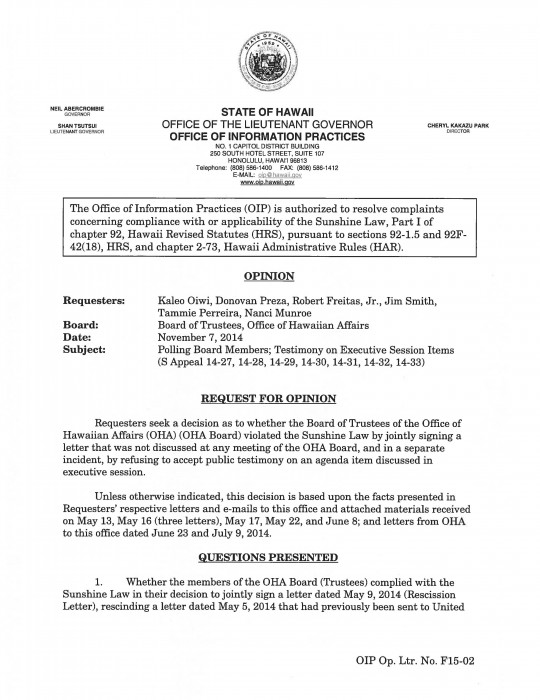
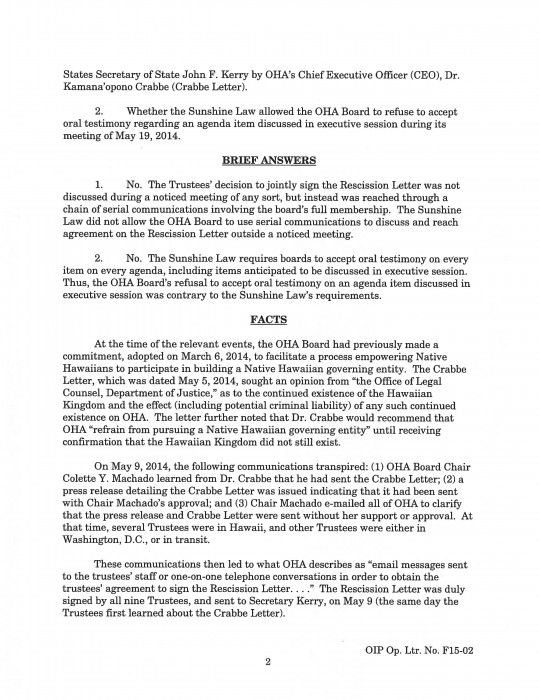
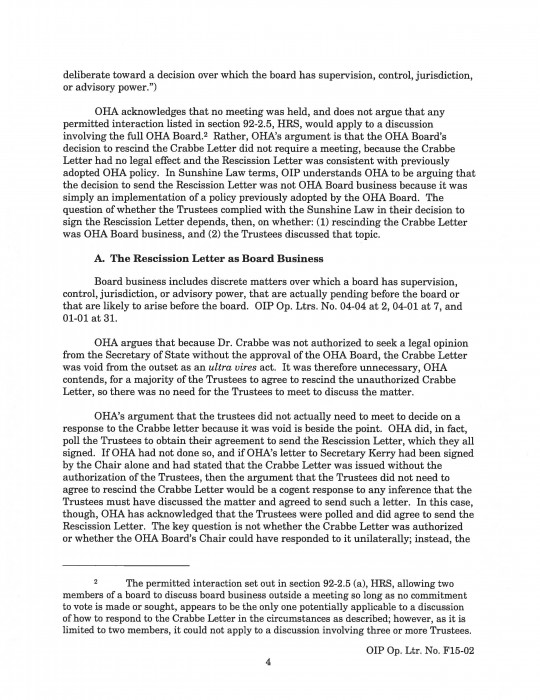
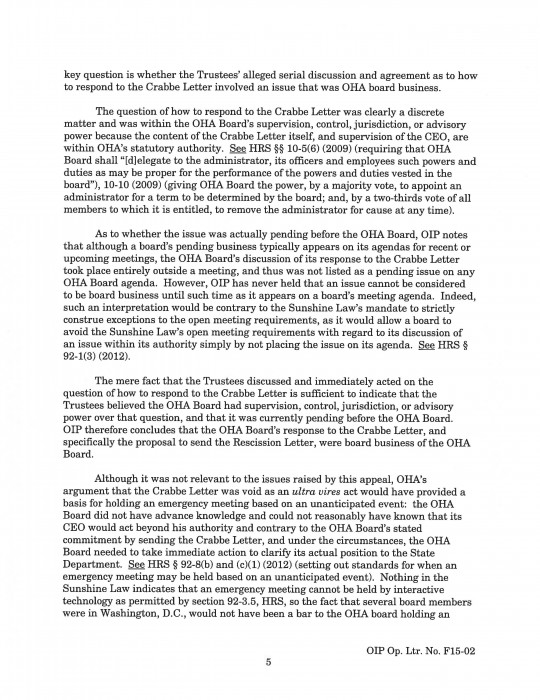
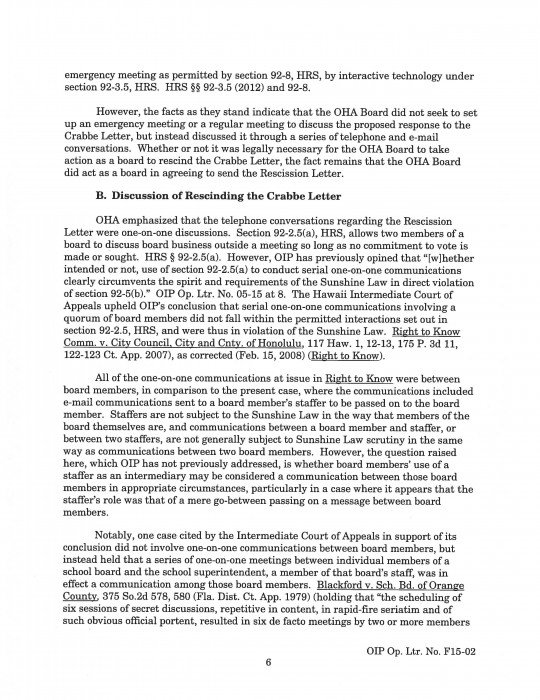
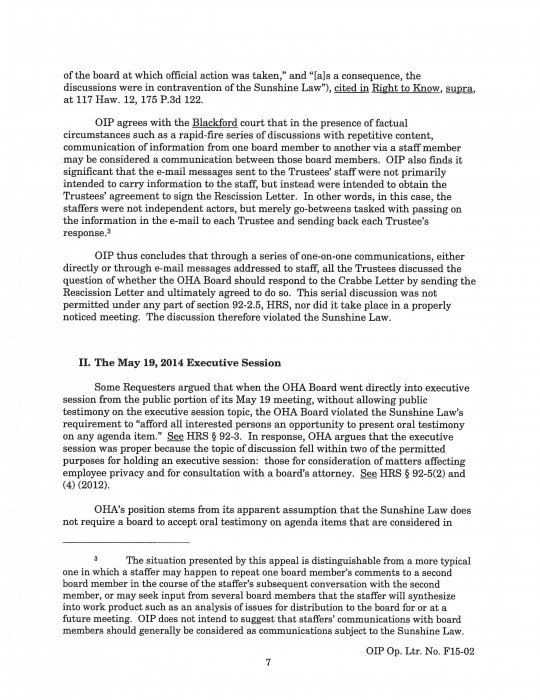
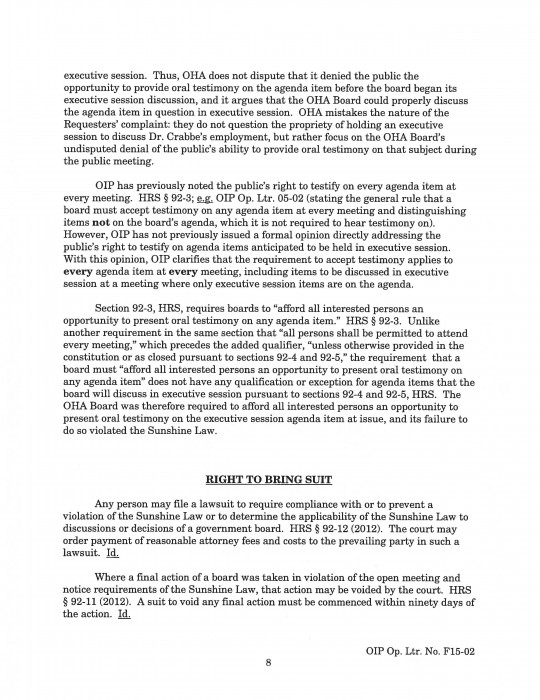
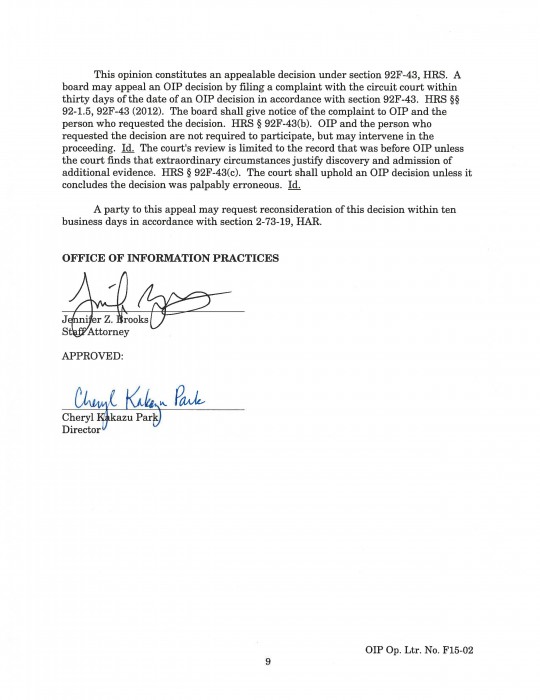
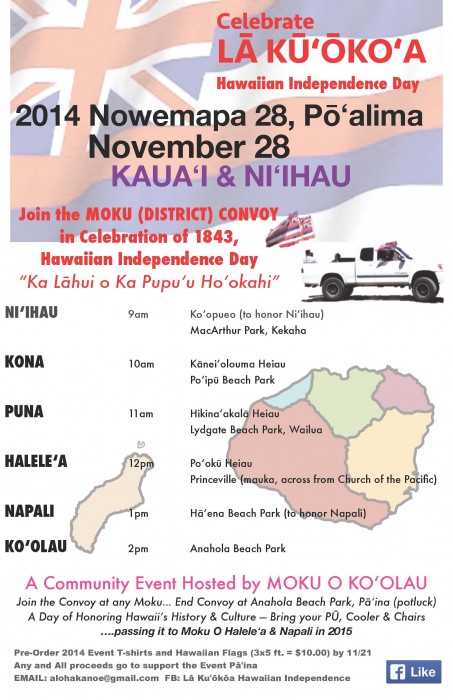
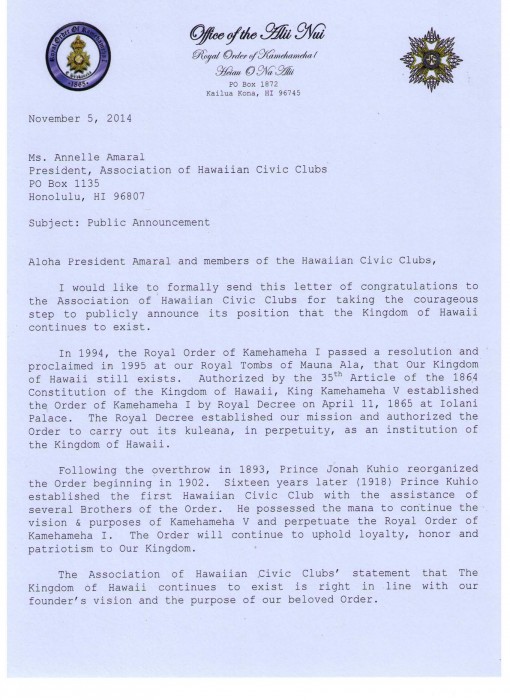
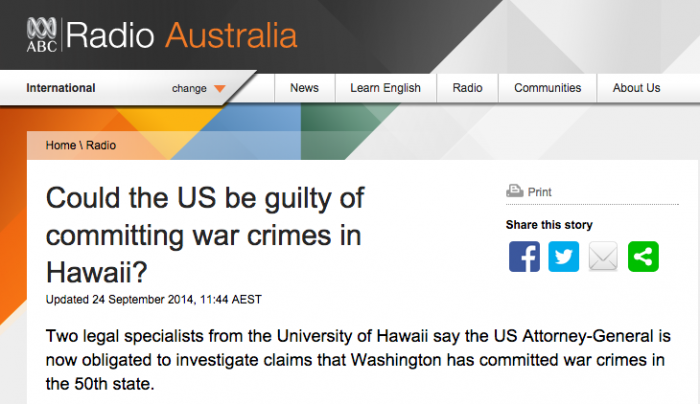
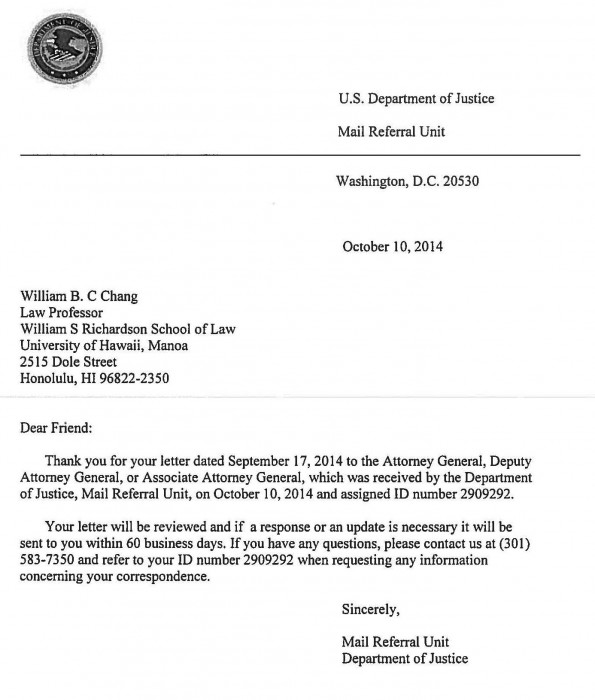
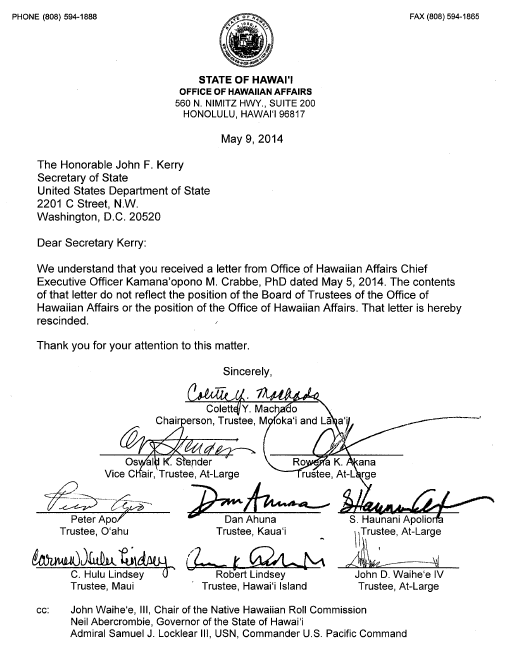
The Office of Information Practices’s (OIP) investigation and conclusion that the Board of Trustees (BOT) of the Office of Hawaiian Affairs (OHA) violated the Sunshine Law effectively voided the BOT’s May 9, 2014 letter to U.S. Secretary of State John Kerry rescinding OHA’s CEO Dr. Kamana‘opono Crabbe’s May 5, 2014 letter to the Secretary seeking clarification on the legal status of the Hawaiian Kingdom under international law.
At the center of the controversy was whether or not the BOT violated the Sunshine Law, which according to the OIP Guide to the Sunshine Law for State and County Boards, “the intent of the Sunshine Law is to open up governmental processes to public scrutiny and participation by requiring state and county boards to conduct their business as openly as possible. The Legislature expressly declared that ‘it is the policy of this State that the formation and conduct of public policy—the discussions, deliberation, decisions, and actions of governmental agencies—shall be conducted as openly as possible.’”
The BOT attempted to justify their actions to rescind by taking the position that there was no Board meeting in Washington, D.C., that would have come under the scrutiny of the Sunshine Law. According to the OIP, “OHA’s argument is that the OHA Board’s decision to rescind the Crabbe Letter did not require a meeting, because the Crabbe Letter had no legal effect and the Rescission Letter was consistent with previously adopted OHA policy.”
It is unimaginable how the BOT could have construed Dr. Crabbe’s Letter as being inconsistent with OHA policy, when he was merely seeking information in order to inform the Trustees regarding policy. Dr. Crabbe’s Letter opened with, “As the Chief Executive Officer of the Office of Hawaiian Affairs, being a governmental agency of the State of Hawai‘i, the law places on me, as a fiduciary, strict standards of diligence, responsibility and honesty. My executive staff, as public officials, carry out the policies and directives of the Trustees of the Office of Hawaiian Affairs in the service of the Native Hawaiian community. We are responsible to take care, through all lawful means, that we apply the best skills and diligence in the servicing of this community. It is in this capacity and in the interest of the Office of Hawaiian Affairs I am submitting this communication and formal request.”
After Dr. Crabbe explained the situation and circumstances that led him to seek clarification on the legal status of the Hawaiian Kingdom under international law, he concluded, “While I await the opinion from the Office of Legal Counsel, I will be requesting approval from the Trustees of the Office of Hawaiian Affairs that we refrain from pursuing a Native Hawaiian governing entity until we can confirm that the Hawaiian Kingdom, as an independent sovereign State, does not continue to exist under international law and that we, as individuals, have not incurred any criminal liability in this pursuit.”
OHA did hold a meeting in Washington, D.C., on May 9, 2014, where Dr. Crabbe could have made his request to the Trustees as stated in his letter, but instead the Trustees held a closed meeting that did not include Dr. Crabbe. In this meeting, not all of the Trustees were in Washington, D.C., but some were still in Hawai‘i.
The meeting was a haphazard mix of emails, telephone conversations and face-to-face conversations amongst the Trustees, which concluded Dr. Crabbe’s Letter to be “void as an ultra vires act.” This resulted in another letter, with OHA’s letterhead, sent to Secretary Kerry rescinding Dr. Crabbe’s Letter where all nine Trustees provided their signatures. This so-called letter to rescind clearly showed that the action taken by the Trustees was a Board matter and therefore subject to the scrutiny of the Sunshine Law. Since the OIP concluded that the meeting was illegal, anything stemming from an illegal meeting is “void,” which includes the Trustees decision that concluded Dr. Crabbe’s Letter was “void as an ultra vires act.” In other words, the only valid act by OHA in these circumstances is Dr. Crabbe’s May 5 letter to Secretary Kerry.
OHA Trustees Dan Ahuna and Hulu Lindsey removed their names from the May 9 letter after conferring with Dr. Crabbe and both concurred that he was authorized to send his letter to Secretary Kerry to seek clarifications.
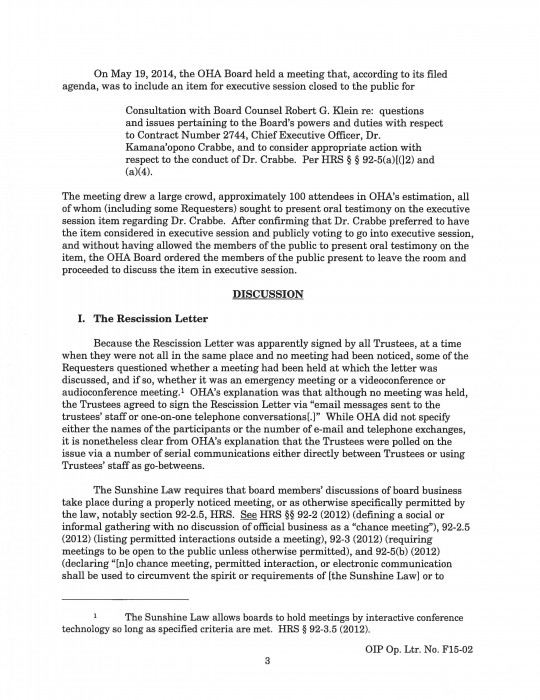
The other violation of the Sunshine Law was when the Trustees refused to accept oral testimony on an agenda item of a BOT meeting on May 19, 2014 in Honolulu where the Trustees were going into closed session to discuss the fate of Dr. Crabbe and his letter to Secretary Kerry. It was stated on the agenda that the BOT would go into executive session for “Consultation with Board Counsel Robert G. Klein re: questions and issues pertaining to the Board’s powers and duties with respect to Contract Number 2744, Chief Executive Officer, Dr. Kamana‘opono Crabbe, and to consider appropriate action with respect to the conduct of Dr. Crabbe.”
According to the minutes of that meeting, attorney Dexter Kaiama, stated to the BOT:
 “The Sunshine Law states that any meeting held by the Trustees is required to allow public community testimony. He respectfully submits that failure to allow public testimony prior to going into executive session would be a violation of the Sunshine Laws. He is aware that OHA is in receipt of an OIP complaint regarding its May 9, 2014, letter signed by the Board of Trustees. The complaint questions the appropriateness of the actions taken by the Trustees at that time. In order to keep with the spirit of the law, he offers that no executive session be taken regarding item II.A. relating to Dr. Kamana‘opono Crabbe. The letter is inextricably intertwined with the actions the Board seeks to discuss this morning concerning Dr. Kamana‘opono Crabbe. If those actions of May 9th violate Sunshine Laws then these additional actions may also be in violation. He asks that no action take place until the Office of Information Practices completes its investigation.”
Former Hawai‘i Supreme Court Justice Robert G. Klein, who is retained by the BOT as their legal counsel, responded by stating:
 “the Board is entitled to go into executive session on this matter without public comment because this is purely an executive session matter. With respect to the letter it is irrelevant to the decision to go into executive session inasmuch as this meeting has been duly and properly noticed for the purposes of the agenda item. Due to the fact that there is no public portion of the meeting it is not necessary to take public comment. He respectfully disagrees with attorney Kaiama and advises the Board that it is free to go into executive session without public comment.”
In light of the OIP’s findings, the advise given to the BOT at this meeting by their legal counsel was not only bad advise, but it was Klein’s legal advise for the BOT to violate the Sunshine Law, which carries a punishment of up to a year in prison, a fine, and removal from the Board. It is not clear whether the BOT consulted Klein during their “unlawful” meeting in Washington, D.C., but he was clearly consulted during the Board meeting in Honolulu on May 19, 2014 as reflected in the minutes. If he was consulted in Washington, D.C., he again gave advice to violate the Sunshine Law in light of the OIP’s investigation. As a former Hawai‘i Supreme Court Justice, Klein cannot claim ignorance of the Sunshine Law and it would appear to be a case of legal malpractice at the very least.
The attorney that gave the best legal advice at the Honolulu meeting was Mr. Kaiama, but the Trustees didn’t listen when they should have.