The Significance of the 2000 Sai-Clinton Agreement—A Treaty under International Law

In April of 2000 began an exchange of diplomatic notes between the Hawaiian Kingdom Government and the United States Government, and between the Hawaiian Kingdom Government and the Permanent Court of Arbitration, The Hague, Netherlands. International arbitration proceedings were initiated by Lance Larsen’s legal counsel filing a notice of arbitration with the Permanent Court on November 8, 1999. At the center of the international dispute was the allegation by the claimant—Larsen, that the respondent—the Government of the Hawaiian Kingdom was liable “for allowing the unlawful imposition of American municipal laws over the claimant’s person within the territorial jurisdiction of the Hawaiian Kingdom.”

Before the arbitral tribunal was formed by the Permanent Court on June 9, 2000, in Larsen v. Hawaiian Kingdom, Tjaco T. van den Hout, Secretary General of the Permanent Court, spoke with the Chairman of the Council of Regency, David Keanu Sai, who served as agent for the Hawaiian Kingdom, over the telephone and recommended that the Hawaiian Government provide an invitation to the United States to join in the arbitration.

On April 3, 2000, the first diplomatic note was delivered by Chairman Sai to John R. Crook, Assistant Legal Adviser, United States Department of State. This note covered a conference call meeting in Washington, D.C., on that day between Chairman Sai, Crook, and Ms. Ninia Parks, legal counsel for Lance Larsen, where the Government of the Hawaiian Kingdom provided a formal invitation for the United States to join in international arbitration proceedings already in train at the Permanent Court, in Larsen v. Hawaiian Kingdom.

A copy of the note was sent to the Permanent Court’s Registry for record that the United States was invited to join in the arbitral proceedings. Under international law, this note served as an offering instrument that contained the following language:

[T]he reason for our visit was the offer by the…Hawaiian Kingdom, by consent of the Claimant [Larsen], by his attorney, Ms. Ninia Parks, for the United States Government to join in the arbitral proceedings presently instituted under the auspices of the Permanent Court of Arbitration at The Hague, Netherlands. … [T]he State Department should review the package in detail and can get back to the Acting Council of Regency by phone for continued dialogue. I gave you our office’s phone number…, of which you acknowledged. I assured you that we did not need an immediate answer, but out of international courtesy the offer is still open, notwithstanding arbitral proceedings already in motion. I also advised you that Secretary-General van den Hout of the Permanent Court of Arbitration was aware of our travel to Washington, D.C. and the offer to join in the arbitration. As I stated in our conversation he requested that the dialogue be reduced to writing and filed with the International Bureau of the Permanent Court of Arbitration for the record, and you acknowledged.

Thereafter, the Permanent Court’s Deputy Secretary General, Phyllis Hamilton, informed Chairman Sai over the phone that Cynthia Perrin Schneider, Ambassador of the United States to the Kingdom of the Netherlands, notified the Hawaiian Kingdom, through the Permanent Court, that the United States declined the invitation to join the arbitral proceedings. Ambassador Schneider was representing Bill Clinton, President of the United States. Instead, the United States requested permission from the Hawaiian Government to have access to the pleadings and records of the Larsen case at the Registry of the Permanent Court. Chairman Sai consented to this request. The Permanent Court, represented by the Deputy Secretary General, served as an intermediary to secure an agreement, by exchange of notes, between the Hawaiian Kingdom and the United States.

According to Johst Wilmanns, in his article “Note Verbale,” published in the Encyclopedia of Public International Law, “Legally there is no difference between a formal note, a note verbale and a memorandum. They are all communications which become legally operative upon the arrival at the addressee. The legal effects depend on the substance of the note, which may relate to any field of international relations.” And according to Cendric van Assche, in her chapter “1969 Vienna Convention,” in The Vienna Conventions on the Law of Treaties, A Commentary, “the exchange of two notes […] constituting an agreement satisfies the definition of the term ‘treaty’ as provided by Article 2(1)(a) of the Vienna Convention.”

This treaty providing permission for the United States to access all records and pleadings of the Larsen case at the Registry of the Permanent Court is called the 2000 Sai-Clinton agreement. Coincident with this treaty is the recognition of the continued existence of the Hawaiian Kingdom since the nineteenth century and the Council of Regency as its interim government. The 2000 Sai-Clinton agreement has similar parallels to the 1933 Roosevelt-Litvinov agreement where the United States recognized the Soviet Government.

The offer by the Permanent Court’s Secretary General to have the Hawaiian Government provide the United States an invitation to join in the arbitral proceedings, and the Hawaiian Government’s acceptance of this offer, also constitutes an international agreement between the Permanent Court and the Hawaiian Kingdom. According to J.L. Weinstein, in his article, “Exchange of Notes,” in the British Yearbook of International Law, “the growth of international organizations and the recognition of their legal personality has resulted in agreements being concluded by an exchange of notes between such organizations and states.” This treaty is called the Sai-van den Hout agreement.

There is no question of law or fact that by virtue of the Sai-Clinton agreement, the United States recognizes the continued existence of the Hawaiian Kingdom since the nineteenth century and that American laws and administrative measures being imposed within the territory of the Hawaiian Kingdom is UNLAWFUL. Section 6 and 8 of the Hawaiian Kingdom Civil Codes states:

§6. The laws are obligatory upon all persons, whether subjects of this kingdom, or citizens or subjects of any foreign State, while within the limits of this kingdom, except so far as exception is made by the laws of nations in respect to Ambassadors or others. The property of all such persons, while such property is within the territorial jurisdiction of this kingdom, is also subject to the laws.

§8. Whatever is done in contravention of a prohibitory law is void, although the nullity be not formally directed.

As a result, the United States, through its State of Hawai‘i, must begin to comply with the international law of occupation and begin to administer the laws of the Hawaiian Kingdom, which the provisional laws proclaimed in 2014, until there is a treaty of peace. Under the law of occupation, the State of Hawai‘i must transform itself into a Military Government. The Council of Regency has published its Operational Plan for Transitioning the State of Hawai‘i into a Military Government in 2023 with essential and implied tasks.

Oh What a Tangled Web We Weave, When First We Practice to Deceive! The Recognition by the United States of the Hawaiian Kingdom and the Kamehameha Schools Lawsuit

International law is the set of rules, norms, and standards that govern relations between sovereign and independent States, and international organizations. An example of an international organization is the Permanent Court of Arbitration, which is an intergovernmental organization comprised of government representatives of independent States.

The main sources of international law are international agreements called convention or treaties, international custom, and general principles of law recognized by civilized nations. International custom is also called customary international law, which is a set of unwritten, binding legal rules derived from the consistent, general practices of independent States, rather than formal written treaties.

There are two components of customary international law—the “what,” which is the specific practice of States, and the “why,” which is the reason a State does the specific practice. The former is called State practice, and the latter is called opinio juris where the States must act out of a sense of legal obligation and not just because it wants to. Opinio juris is Latin that means “opinion of law or practice.” The action of a State can include its silence, which is an act of acquiescence.

When the Permanent Court recognized the Hawaiian Kingdom’s continued existence as an independent State and the Council of Regency as its interim government, in Larsen v. Hawaiian Kingdom, it was an act taken by an intergovernmental organization. Professor Michael Akehurst, in his article “Custom as a Source of International Law,” stated that because intergovernmental organizations are comprised of representatives of States, “their practice is best regarded as the practice of States.” So, when none of the current 127 States that comprise the Permanent Court, which includes the United States, objected to the Permanent Court’s act of recognizing the Hawaiian Kingdom, they did so because of a legal obligation.

That legal obligation is that international law clearly states that the State continues to exist despite its government being militarily overthrown. This is why the State of Iraq continued to exist despite the United States military overthrow of the Iraqi government during the Second Gulf War. This was called the American occupation of Iraq. And that the only way the United States could acquire the territory and sovereignty of the Hawaiian Kingdom is by a treaty of cession. There is no such treaty that the Hawaiian Kingdom ceded its territory and sovereignty to the United States. There only exists the unlawful imposition of American laws over the territory of the Hawaiian Kingdom since 1898. Like any of the laws of a State, American laws have no effect outside of its territorial borders.

There are two significant acts by the Permanent Court that the United States did not object to. The first significant act are the Permanent Court’s annual reports from 2001-2011 that stated the jurisdiction of the Permanent Court for the Larsen v. Hawaiian Kingdom arbitration was by virtue of Article 47 of the 1907 Hague Convention for the Pacific Settlement of International Disputes, which established the Permanent Court. Article 47 states, “The jurisdiction of the Permanent Court may, within the conditions laid down in the regulations, be extended to disputes [with] non-Contracting Powers.” Under international law “Powers” and “States” are used interchangeably.

Because the Hawaiian Kingdom did not sign the 1907 Hague Convention, it is considered a non-Contracting Power. There are currently 125 Contracting Powers to the 1907 Hague Convention who are also Contracting States to the United Nations Charter. Of the 193 Member States of the United Nations, 68 are non-Contracting Powers to the 1907 Hague Convention like the Hawaiian Kingdom. Just as the Hawaiian Kingdom could access the jurisdiction of the Permanent Court to resolve an international dispute, so could these 68 States under Article 47.

The second significant act is the Permanent Court’s case description of the Larsen case on its website, which states:

Lance Paul Larsen, a resident of Hawaii, brought a claim against the Hawaiian Kingdom by its Council of Regency (“Hawaiian Kingdom”) on the grounds that the Government of the Hawaiian Kingdom is in continual violation of: (a) its 1849 Treaty of Friendship, Commerce and Navigation with the United States of America, as well as the principles of international law laid down in the Vienna Convention on the Law of Treaties, 1969 and (b) the principles of international comity, for allowing the unlawful imposition of American municipal laws over the claimant’s person within the territorial jurisdiction of the Hawaiian Kingdom.

Because the United States has not objected to the Permanent Court’s description of the case, it accepts the description as true and accurate. The case description states that the Hawaiian Kingdom, a non-Contracting Power, is represented by the Council of Regency as its Government. The 1849 Treaty of Friendship, Commerce and Navigation between the Hawaiian Kingdom and the United States continues to exist. And that the imposition of American municipal laws within the territorial jurisdiction of the Hawaiian Kingdom is UNLAWFUL.

In the federal lawsuit of Students for Fair Admissions v. Kamehameha Schools, there is a collision of Hawaiian Kingdom laws and American laws. The plaintiff is relying on American laws in its lawsuit, the defendant exists under Hawaiian Kingdom laws, and the federal court is under American law, which the United States, under customary international law, recognizes as UNLAWFUL.

These were the grounds for the Hawaiian Kingdom to intervene by filing a motion on January 21, 2026, in the case to ensure the protection of Kamehameha Schools under Hawaiian Kingdom law as well as customary international law that binds the United States. When Judge Micah Smith denied the Hawaiian Kingdom’s motion to intervene on January 23, 2026, claiming that it gave rise to the political question doctrine, the Hawaiian Kingdom filed a motion for reconsideration on February 3, 2026, because Judge Smith committed a “manifest error” in his judgment.

In its motion for reconsideration, the Hawaiian Kingdom showed why the Judge was in error because the political question only arises if the United States does not currently recognize the Hawaiian Kingdom and the Council of Regency as its government, BUT IT DID.

In the motion, it explained that not only did the United States recognize the Hawaiian Kingdom and the Council of Regency by opinio juris—customary international law as already explained, but also by an executive agreement, being a treaty under international law, where the United States requested permission from the Hawaiian Kingdom, WHICH IT GAVE, to have access to all records and pleadings of the Larsen case. The Deputy Secretary General of the Permanent Court, Phyllis Hamilton, brokered the agreement.

Coincident to the granting of permission was the United States recognition of the Hawaiian Kingdom and the Council of Regency as its interim government. In laymen’s terms, you can’t request permission without first recognizing that you are asking permission from a government that is a defendant in an international arbitration case at the Permanent Court.

It would appear that Judge Smith hit the “pause button.” Where he quickly issued the judgment denying the Hawaiian Kingdom’s motion to intervene just two days after the filing, we are now at seventeen days since the filing of the motion for reconsideration.

Hawaiian Kingdom Files Supplemental Brief for its Motion for Reconsideration in SFFA v. Kamehameha Schools

FOR IMMEDIATE RELEASE
February 16, 2026

Today, the Council of Regency, as interim government of the Hawaiian Kingdom, filed its Motion for Leave to File Supplemental Brief in Support of Motion for Reconsideration with the United States District Court for the District of Hawai‘i, seeking permission of Judge Micah Smith to file its supplemental brief in support of its motion for reconsideration.

The Hawaiian Kingdom explains that the supplemental brief provides vital case law, analysis and context necessary for Judge Smith’s consideration regarding its motion for reconsidering its decision that the Hawaiian Kingdom’s motion to intervene raises the political question doctrine, which prevents the federal court from accepting the filing. The political question doctrine only arises if the United States executive branch has not recognized the sovereignty of a country such as Palestine.

In its motion for reconsideration, the Hawaiian Kingdom provided clear and irrefutable evidence that the United States recognized the continued existence of the Hawaiian Kingdom as a State since the nineteenth century and the Council of Regency as its government by an executive agreement, which is a treaty under international law. As explained in the Hawaiian Kingdom’s motion for reconsideration, this executive agreement granted the United States access to all records and pleadings of the Larsen case at the Permanent Court of Arbitration. The Hawaiian Kingdom also provided clear evidence that the United States, along with the other 126 Contracting States to the Permanent Court of Arbitration, also recognized the Hawaiian Kingdom and the Council of Regency under customary international law—opinio juris.

The Hawaiian Kingdom’s supplemental brief covered two additional areas for Judge Smith to consider. First, the significance of the 1937 decision by the U.S. Supreme Court, in United States v. Belmont, on executive agreements, and second, the legal status of the Kamehameha Schools trust under Hawaiian Kingdom law, but the legal status of the current administration of the trust under American law, which is a war crime under international law.

United States v. Belmont (1937)

In its supplemental brief, the Hawaiian Kingdom drew attention to the circumstances of the Supreme Court’s decision in United States v. Belmont, which is similar in circumstance to the Hawaiian Kingdom’s executive agreement with the United States. In Belmont, the Supreme Court stated:

We take judicial notice of the fact that, coincident with the assignment set forth in the complaint, the President recognized the Soviet Government.

The assignment was effected by an exchange of diplomatic correspondence between the Soviet Government and the United States. The purpose was to bring about a final settlement of the claims and counterclaims between the Soviet Government and the United States, and it was agreed that the Soviet Government would take no steps to enforce claims against American nationals, but all such claims were released and assigned to the United States, with the understanding that the Soviet Government was to be duly notified of all amounts realized by the United States from such release and assignment.

And in respect of what was done here, the Executive had authority to speak as the sole organ of that government. The assignment and the agreements in connection therewith did not, as in the case of treaties, as that term is used in the treaty-making clause of the Constitution (Art. II, § 2), require the advice and consent of the Senate.

We held that, although this might not be a treaty requiring ratification by the Senate, it was a compact negotiated and proclaimed under the authority of the President, and as such was a “treaty” within the meaning of the Circuit Court of Appeals Act, the construction of which might be reviewed upon direct appeal to this court.

Like the assignment being effected by the executive agreement with the Soviet Government, the permission for the United States to access all records and pleadings in the Larsen case was effected by the executive agreement with the Hawaiian Kingdom Government. Coincident to both executive agreements was the United States recognition of the Soviet Government and the Hawaiian Kingdom Government.

Kamehameha Schools established under Hawaiian Kingdom law

By her last Will and Testament dated October 31, 1883, with two codicils dated October 4, 1884, and October 9, 1884, Bernice Pauahi Bishop established a mandate “to erect and maintain in the Hawaiian Islands two schools, each for boarding and day scholars, one for boys and one for girls, to be known as, and called the Kamehameha Schools,” and “to devote a portion of each years income to the support and education of orphans, and others in indigent circumstances, giving the preference to Hawaiians of pure or part aboriginal blood.” She also told her husband, Charles Reed Bishop who became Chair of the Trustees, that aboriginal Hawaiians should have preference in admission. He stated this in his speech at the first Founder’s Day celebration in 1888.

The Will with two codicils were admitted to probate by the Supreme Court of the Hawaiian Kingdom on December 2, 1884. According to article fourteen of the will, she designated Charles R. Bishop, Samuel M. Damon, Charles M. Hyde, Charles M. Cooke, and William O. Smith to be her trustees. On March 4, 1885, these individuals accepted their duties as trustees. The Will provides “that vacancies shall be filled by the choice of a majority of the Justices of the Supreme Court,” and that annual reports “of all receipts and expenditures, and of the condition of said schools,”  shall be made “to the Chief Justice of the Supreme Court, or the highest judicial officer in the country.” 

After President Grover Cleveland completed a presidential investigation into the overthrow of the Government of the Hawaiian Kingdom by United States troops on January 17, 1893, he sent a message to the Congress that the insurgency calling itself the provisional government was “neither a government de facto [in fact] nor de jure [in law],”  and that it “owes its existence to an armed invasion by the United States.”  The President entered into an executive agreement with the Queen where he committed that the United States would reinstate the Queen in office as the Executive Monarch, and the Queen committed that after she’s reinstated she’ll grant amnesty to the insurgents. Due to political wrangling in the Congress, however, the President was unable to carry out its obligation under the executive agreement, which is a treaty under international law, and the insurgents did not receive amnesty.

On July 4, 1894, the insurgency changed its name from the provisional government to the Republic of Hawai‘i and continued to seek annexation by the United States. On March 4, 1897, President Cleveland was succeeded by President William McKinley. President McKinley’s administration favored annexing the Hawaiian Islands for military purposes. At the height of the Spanish-American War, the Congress enacted a joint resolution of annexation on July 6, 1898, and President McKinley signed it into law the following day. The underlying problem is that any law enacted by the Congress has no effect beyond the borders of the United States. Only by means of a treaty with the Hawaiian Kingdom, not with the insurgents, could the United States acquire Hawaiian sovereignty and territory. A joint resolution is not a treaty. Regarding the limits of American laws, the Supreme Court, in Belmont, stated, “our Constitution, laws and policies have no extraterritorial operation unless in respect of our own citizens.”

In 1988, the Department of Justice Office of Legal Counsel (OLC), in a legal opinion, concluded that it is “unclear which constitutional power Congress exercised when it acquired Hawaii by joint resolution. Accordingly, it is doubtful that the acquisition of Hawaii can serve as an appropriate precedent for a congressional assertion of sovereignty over an extended territorial sea.”  The OLC stated:

The constitutionality of the annexation of Hawaii, by a simple legislative act, was strenuously contested at the time both in the Congress and by the press. The right to annex by treaty was not denied, but it was denied that this might be done by a simple legislative act…Only by means of treaties, it was asserted, can the relations between States be governed, for a legislative act is necessarily without extraterritorial force—confined in its operation to the territory of the State by whose legislature it is enacted.

On April 30, 1900, the Congress renamed the Republic of Hawai‘i to the Territory of Hawai‘i and began to impose American laws in the Hawaiian Kingdom in violation of international law.  In 1959, the Congress renamed the Territory of Hawai‘i to the State of Hawai‘i.  The State of Hawai‘i is the direct successor of the provisional government and their laws, being American laws, have no effect within the territory of the Hawaiian Kingdom. Under international law, the imposition of American laws is a war crime called usurpation of sovereignty during military occupation.

Usurpation of sovereignty during military occupation was listed as a war crime in 1919 by the Commission on Responsibilities of the Paris Peace Conference that was established by the Allied and Associated Powers at war with Germany and its allies during the First World War. The Commission was especially concerned with acts perpetrated in occupied territories against non-combatants and civilians. Usurpation of sovereignty during military occupation is the imposition of the laws and administrative policies of the Occupying State over the territory of the Occupied State. The crime of usurpation of sovereignty during military occupation was referred to by Judge Blair of the American Military Commission in a separate opinion in the Justice Case, holding that this “rule is incident to military occupation and was clearly intended to protect the inhabitants of any occupied territory against the unnecessary exercise of sovereignty by a military occupant.”

Because the Queen was not reinstated and the insurgency did not receive amnesty, the Bishop Estate was incapable of operating after January 17, 1893, because the majority of its trustees were insurgents. Furthermore, the Will only provides for the appointment of trustees to be done by the Hawaiian Kingdom Supreme Court and no other. When Charles Hyde, one of the trustees, died October 13, 1898, the Territory of Hawai‘i Supreme Court appointed Alfred W. Carter his successor on January 6, 1900. First, the Territorial Supreme Court is not the Hawaiian Kingdom Supreme Court, and second, Walter F. Frear and William A. Whiting who appointed Carter were insurgents and members of the provisional government. All appointments of trustees after January 17, 1893, were not in accordance with the Will of Bernice Pauahi Bishop, and the operation of Bishop Estate under American law did not affect or change the Estate as it stood on January 17th. The Bishop Estate lapsed into abeyance on January 17, 1893.

The current Trustees of the Kamehameha Schools were all appointed by the State of Hawai‘i Probate Court under American law. Their appointment of Jack Wong as Chief Executive Officer in 2014 was made by Trustees appointed under American law but the Kamehameha Schools trust is under Hawaiian Kingdom law. In its supplemental brief, the Hawaiian Kingdom explained that the current standing of the administration of Kamehameha Schools can be remedied under the provisional laws of the Hawaiian Kingdom so long as the selection of trustees by a probate court are not inconsistent with Hawaiian Kingdom law.

On October 10, 2014, the Council of Regency proclaimed the provisional laws of the Hawaiian Kingdom. The Proclamation stated, “And we do hereby proclaim from the date of this proclamation all laws that have emanated from an unlawful legislature since the insurrection began on July 6, 1887 to the present, to include United States legislation, shall be the provisional laws of the Realm subject to ratification by the Legislative Assembly of the Hawaiian Kingdom once assembled, with the express proviso that these provisional laws do not run contrary to the express, reason and spirit of the laws of the Hawaiian Kingdom prior to July 6, 1887, the international laws of occupation and international humanitarian law, and if it be the case they shall be regarded as invalid and void.”

The obligatory nature of this Proclamation is expressed in section 6 of the Hawaiian Civil Code that states:

The laws are obligatory upon all persons, whether subjects of this kingdom, or citizens or subjects of any foreign State, while within the limits of this kingdom, except so far as exception is made by the laws of nations in respect to Ambassadors or others. The property of all such persons, while such property is within the territorial jurisdiction of this kingdom, is also subject to the laws.”

The Council of Regency would consider that the selection of Kamehameha Schools Trustees by a State of Hawai‘i Probate Court, and not the Supreme Court, “do not run contrary to the express, reason and spirit of the laws of the Hawaiian Kingdom prior to July 6, 1887, the international laws of occupation and international humanitarian law” given the circumstances for that change.

The Council of Regency is represented by Hawaiian attorney Edward Halealoha Ayau of the Law Office of Edward Halealoha Ayau.

MEDIA CONTACT:

Dr. David “Keanu” Sai, Ph.D.
Chairman of the Council of Regency
Acting Minister of the Interior
Acting Minister of Foreign Affairs ad interim
Email: interior@hawaiiankingdom.org

Checkmate: The significance of the Hawaiian Kingdom’s filing of its Motion for Reconsideration in the Kamehameha Schools lawsuit

The federal courts of the United States represent a higher level of standard than courts within the various States of the American Union. What is at its core is the “rule of law” that provides legal predictability, continuity, and coherence; reasoned decisions made through publicly visible processes and based faithfully on the law. U.S. District Courts, unlike the Appellate Courts, have trials that apply the rule of law in filings, proceedings and evidence. You don’t have trials at the Appellate Court.

Rule 11(b) of the Federal Rules of Civil Procedure addresses representations to the Court. “By presenting to the court a pleading, written motion, or other paper…an attorney…certifies that to the best of the person’s knowledge, information, and belief, formed after an inquiry reasonable under the circumstances: (1) it is not being presented for any improper purpose, such as to harass, cause unnecessary delay, or needlessly increase the cost of litigation; (2) the claims, defenses, and other legal contentions are warranted by existing law or by a nonfrivolous argument for extending, modifying, or reversing existing law or for establishing new law; (3) the factual contentions have evidentiary support or, if specifically so identified, will likely have evidentiary support after a reasonable opportunity for further investigation or discovery; and (4) the denials of factual contentions are warranted on the evidence or, if specifically so identified, are reasonably based on belief or a lack of information.”

If an attorney files any written motion that violates these conditions, he/she can be sanctioned by the Court under Rule 11(c)(1), which states, “If, after notice and a reasonable opportunity to respond, the court determines that Rule 11(b) has been violated, the court may impose an appropriate sanction on any attorney, law firm, or party that violated the rule or is responsible for the violation. Absent exceptional circumstances, a law firm must be held jointly responsible for a violation committed by its partner, associate, or employee.” In other words, if a motion is frivolous, the attorney can be sanctioned.

The basis of this rule would also apply to Declarations made in support of a motion where the declarant would have committed the crime of perjury if what was stated in the Declaration are false statements. This comes under U.S. Federal law 18 U.S.C. §1621 and §1623. This is why in Declarations filed with Federal Courts it states, “I declare under penalty of perjury that the foregoing is true and correct to the best of my knowledge.”

Rule 11(b)(2) applies to the content of the Hawaiian Kingdom’s Motion for Reconsideration, which is “warranted by existing law.” In the District Courts, along with constitutional provisions and statutes, existing law includes Federal Court decisions that came before the Appellate Courts or the Supreme Court.

In the Hawaiian Kingdom’s Motion for Reconsideration, it provided clear evidence of two instances that the United States recognized the continued existence of the Hawaiian Kingdom and the Council of Regency as its government while administrative proceedings took place at the Permanent Court of Arbitration, The Hague, Netherlands, in Larsen v. Hawaiian Kingdom (1999-2001).

The first instance was by executive agreement between the Council of Regency and the United States, by its Embassy in the Netherlands, that provided permission to the United States to access all records and pleadings of the case. Under international law, this is called an executive agreement, by exchange of notes. Pertinent Supreme Court decisions on this subject of executive agreements that were cited in the Motion for Reconsideration are United States v. Belmont (1937), United States v. Pink (1942), and American Ins. Ass’n v. Garamendi (2003).

In Garamendi, the Supreme Court stated, “our cases have recognized that the President has authority to make ‘executive agreements’ with other countries, requiring no ratification by the Senate […] this power having been exercised since the early years of the Republic.”

In Belmont, the Supreme Court stated, “an international compact […] is not always a treaty which requires the participation of the Senate.”

And in Pink, the Supreme Court stated, “all international compacts and agreements’ are to be treated with similar dignity, for the reason that ‘complete power over international affairs is in the national government, and is not and cannot be subject to any curtailment or interference on the part of the several states.”

The significance on the executive agreement between the Hawaiian Kingdom and the United States is stated by the Supreme Court in Garamendi where, “valid executive agreements are fit to preempt state law, just as treaties are.” In other words, the executive agreement negates the legal existence of the State of Hawai‘i, and the consequences of this executive agreement where the United States recognizes the continued existence of the sovereignty of the Hawaiian Kingdom over the Hawaiian Islands is clearly stated by the Supreme Court in Jones v. United States (1890). In Jones, the Supreme Court stated:

By the constitution of the United States, the President is invested with certain important political powers, in the exercise of which he is to use his own discretion, and is accountable only to his country in his political character, and to his own conscience. […] He is the mere organ by whom that will is communicated. The acts of such an officer, as an officer, can never be examinable by the courts.”

In Jones, the Supreme Court also stated that recognition of the sovereignty of a State “conclusively binds the judges, as well as all other officers, citizens, and subjects of that government.” In other words, this executive agreement of recognition binds District Court Judge Micah Smith, the Plaintiffs Student for Fair Admission and the Defendant Kamehameha Schools and that it “can never be examinable by the courts” of the United States, which includes State courts.

The Court, together with the Plaintiffs and the Defendant, are not the contracting parties to the executive agreement, but are bound not to question or examine it, unless they can provide evidence that there is no such executive agreement ever made. To do so, however, is to have the United States Attorney General intervene in the case and provide evidence that there is no such thing as an executive agreement between the Hawaiian Kingdom and the United States, a claim that would be considered frivolous under Rule 11(b). Therefore, the U.S. Attorney General, after intervening in the lawsuit, will have to counter the evidential basis of the executive agreement in the Hawaiian Kingdom’s Motion for Reconsideration. As a contracting party to the executive agreement, only the United States can examine the evidence of the executive agreement.

The second instance was by opio juris—customary international law where none of the Contracting States to the treaty that formed the Permanent Court, to include the United States, did not object to the Permanent Court’s recognition of the continued existence of the Hawaiian Kingdom and the Council of Regency as its government in order for it to have established the arbitration tribunal on June 9, 2000. This was explained in a legal opinion by Federico Lenzerini, a professor of international law at the University of Siena, Italy, which was Exhibit 1 attached to his Declaration that was filed with the Motion for Reconsideration.

The Supreme Court has recognized that the writings of legal scholars are a source of customary international law. In the Paquete Habana case (1900), the Supreme Court stated, “the works of jurists and commentators, who by years of labor, research and experience, have made themselves peculiarly well acquainted with the subjects they treat. Such works are resorted to by judicial tribunals, not for the speculations of their authors concerning what the law ought to be, but for trustworthy evidence of what the law really is.”

These scholars also include Professor Matthew Craven’s legal opinion on the continuity of the Hawaiian Kingdom as a State under international law, which is Exhibit B attached to the Hawaiian Kingdom’s Motion to Intervene; Professor Federico Lenzerini’s legal opinion on the authority of the Council of Regency of the Hawaiian Kingdom attached as Exhibit D to the Motion to Intervene; and Professor William Schabas’ legal opinion on war crimes related to the American occupation of the Hawaiian Kingdom attached as Exhibit E to the Motion to Intervene.

As they say in the game of chess, checkmate, which is where there is no possible escape for the United States.

Hawaiian Kingdom Moves for the Court to Reconsider its Denial of its Motion to Intervene in SFFA v. Kamehameha Schools

FOR IMMEDIATE RELEASE
February 3, 2026

Today, the Council of Regency, as interim government of the Hawaiian Kingdom, filed its Motion for Reconsideration with the United States District Court for the District of Hawai‘i, seeking reconsideration of Judge Micah Smith’s January 23, 2026, Order to deny the Hawaiian Kingdom’s Motion to Intervene in the case between Students for Fair Admissions and the Kamehameha Schools filed on January 21, 2026.

The Hawaiian Kingdom argues that the Court committed “manifest errors of law” including its misapplication of the political question doctrine at the intervention stage. ​ Rule 24 of the Federal Rules of Civil Procedure only requires a legally protectable interest related to the subject of the action to permit intervention, conclusively established by the Hawaiian Kingdom in its initial Motion to Intervene.  Judge Smith, in his Order, manifestly erred by stating that intervention would require adjudication of issues constitutionally committed to the political branches.

​The political question doctrine bars federal courts from adjudicating disputes that are “textually committed” by the U.S. Constitution to another branch or lack judicially manageable standards to resolve. In the case of Hawai‘i, the court invoked this doctrine because prior courts asserted that the United States executive branch has not recognized the Hawaiian Kingdom. In this case, the Hawaiian Kingdom provides conclusive evidence that this is incorrect.

The United States did recognize the Hawaiian Kingdom during arbitration proceedings at the Permanent Court of Arbitration in Larsen v. Hawaiian Kingdom from 1999-2001.

First, the United States explicitly recognized the Hawaiian Kingdom and the Council of Regency as a matter of opinio juris, under customary international law, when it did not object to the Permanent Court’s recognition of the Hawaiian Kingdom and the Council of Regency before it formed the arbitration tribunal on June 9, 2000. An example of such customary international practice occurred when Palestine became a contracting State to the treaty on October 30, 2015, that formed the Permanent Court, the United States filed a protest with the Dutch Foreign Ministry that stated “the government of the United States considers that ‘the State of Palestine’ does not answer to the definition of a sovereign State and does not recognize it as such.”

Second, the United States explicitly recognized the continued existence of the Hawaiian Kingdom as a State since the nineteenth century and the Council of Regency as its government when it entered into an executive agreement with the Council of Regency that allowed the United States, through its Embassy, in The Hague, Netherlands, to access records and pleadings of the case.

If Hawai‘i was legally the 50th State of the American Union and not the State of the Hawaiian Kingdom, customary international practice obligates the United States to have protested the Permanent Court’s recognition of the Hawaiian Kingdom’s continued existence and the Council of Regency as its government. Customarily, its failure to protest, binds the United States’ (as well as all countries of the Permanent Court) recognition of the continued existence of the Hawaiian Kingdom and the Council of Regency as its government.

Moreover, the United States would not be able to say that the State of Hawai‘i is lawful because at the center of the dispute between Larsen and the Hawaiian Kingdom was the unlawful imposition of American laws over the territory of the Hawaiian Kingdom. On its website the Permanent Court described the Larsen v. Hawaiian Kingdom case as:

Lance Paul Larsen, a resident of Hawaii, brought a claim against the Hawaiian Kingdom by its Council of Regency (“Hawaiian Kingdom”) on the grounds that the Government of the Hawaiian Kingdom is in continual violation of: (a) its 1849 Treaty of Friendship, Commerce and Navigation with the United States of America, as well as the principles of international law laid down in the Vienna Convention on the Law of Treaties, 1969 and (b) the principles of international comity, for allowing the unlawful imposition of American municipal laws over the claimant’s person within the territorial jurisdiction of the Hawaiian Kingdom.

The State Hawai‘i was established in 1959 by an American law, which would make its existence unlawful under international law.

In its arbitration award in Larsen v. Hawaiian Kingdom, the arbitration tribunal stated that “in the nineteenth century the Hawaiian Kingdom existed as an independent State recognized as such by the United States of America, the United Kingdom and various other States, including by exchanges of diplomatic or consular representatives and the conclusion of treaties.”

The Permanent Court’s institutional recognition of the Hawaiian Kingdom prevents the United States, under international law, from denying its existence today as a sovereign State, unless the United States can show it extinguished the Hawaiian Kingdom under international law. To have extinguished the Hawaiian Kingdom under international law it would have to show that the Hawaiian Kingdom ceded or transferred its sovereignty and territory to the United States by a treaty of cession. There is no such evidence.

Significantly, NONE of the current 126 Contracting States to the treaty that formed the Permanent Court, to include the United States, objected to the Permanent Court’s conclusion that the Hawaiian Kingdom continues to exist and that it is a non-Contracting State under Article 47 of the treaty permitting the Hawaiian Kingdom access to the Permanent Court. Article 47 states, the “jurisdiction of the Permanent Court may…be extended to disputes [with] non-Contracting Powers.” In international law, “Powers” is used interchangeably with “States.”

This means the following 126 States also recognize the Hawaiian Kingdom and the Council of Regency by opinio juris—customary international law:

Albania, Argentina, Armenia, Australia, Austria, The Bahamas, Bahrain, Bangladesh, Belarus, Belgium, Belize, Benin, Brazil, Bulgaria, Burkina Faso, Cambodia, Cameroon, Canada, Chile, Colombia, the Democratic Republic of the Congo, Costa Rica, Croatia, Cuba, Cyprus, Czechia, the Democratic Republic of São Tomé and Príncipe, Denmark, Djibouti, Dominican Republic, Ecuador, Egypt, El Salvador, Eritrea, Estonia, Eswatini, Ethiopia, Fiji, Finland, France, Georgia, Germany, Greece, Guatemala, Guyana, Haiti, Honduras, Hungary, Iceland, India, Iran, Iraq, Ireland, Israel, Italy, Japan, Jordan, Kenya, Kuwait, Kyrgyzstan, Lao People’s Democratic Republic, Latvia, Lebanon, Libya, Lithuania, Liechtenstein, Lithuania, Luxembourg, Madagascar, Malaysia, Malta, Mauritius, Mexico, Mongolia, Montenegro, Morocco, Netherlands, New Zealand, Nicaragua, Nigeria, North Macedonia, Norway, Pakistan, Palestine, Panama, Paraguay, the People’s Republic of China, Peru, Philippines, the Plurinational State of Bolivia, Poland, Portugal, Qatar, Romania, Republic of Korea, Russian Federation, Rwanda, Saudi Arabia, Senegal, Serbia, Singapore, Slovak Republic, Slovenia, South Africa, Spain, Sri Lanka, Sudan, Suriname, Sweden, Switzerland, Thailand, Timor-Leste, Togo, Türkiye, Uganda, Ukraine, United Arab Emirates, United Kingdom of Great Britain and Northern Ireland, United States of America, Uruguay, Vanuatu, Venezuela, Viet Nam, Zambia, and Zimbabwe.

All Hawaiian Kingdom treaty partners, to include the United States, are also Contracting States to the treaty that formed the Permanent Court, and these treaties have not been terminated. These treaties are also binding on the successor States of the Hawaiian Kingdom treaty partners. A successor State is a former colony of a State that gained its independence. Examples of successor States are Vietnam who was a former colony of France and New Zealand who was a former colony of Great Britain. Currently, the Hawaiian Kingdom has treaties with 153 Member States of the United Nations, of which 14 treaties are with original States and 139 treaties are with successor States.

Judge Smith’s Order created further manifest error when he prematurely and improperly expanded the court’s review for intervention, under Rule 24 of the Federal Rules of Civil Procedure, in stating that the Hawaiian Kingdom’s intervention made “arguments about the proper interpretation of federal law and the Constitution of the United States, and refer to materials that might aid in interpreting both,” and that Plaintiffs (SSFA) and Defendant (Kamehameha Schools) “are ably represented by counsel fully capable of submitting and raising arguments based on any such pertinent materials.” 

In its Motion for Reconsideration, the Hawaiian Kingdom provides evidence that Kamehameha Schools explicitly decided not to represent the Hawaiian Kingdom’s interests as a sovereign and independent State under international law. ​ Conversely, it defies reason to presume that Plaintiff SSFA would either raise or assert the application of Hawaiian Kingdom law resulting in the very extinguishment of its complaint.  This decision prompted the Hawaiian Kingdom to file its motion to intervene, as it believes neither the Plaintiffs nor the Defendant will adequately represent its interests. ​

The Hawaiian Kingdom references various legal cases and opinions, including State of Hawai‘i v. Lorenzo and United States v. Goo, which establish an evidentiary standard for proving the Hawaiian Kingdom’s continued existence as a sovereign State.​ It also cites international law principles, treaties, and legal opinions conclusively establishingthe Hawaiian Kingdom’s claims. ​The Hawaiian Kingdom’s motion for reconsideration has met that evidentiary standard of the Hawaiian Kingdom’s continued existence.

The Hawaiian Kingdom requests Judge Smith to reconsider its denial of the motion to intervene, arguing that the court’s decision was based on manifest errors of law and that the Hawaiian Kingdom has a legally protectable interest in the case. ​ It emphasizes the United States’ recognition of the Hawaiian Kingdom and the failure of Kamehameha Schools to represent its interests as a basis to grant its motion to intervene. ​​

The Council of Regency is represented by Hawaiian attorney Edward Halealoha Ayau of the Law Office of Edward Halealoha Ayau.

DOWNLOAD FILED HAWAIIAN KINGDOM PLEADINGS:

Motion for Reconsideration

Memorandum of Law in Support of Motion for Reconsideration

Declaration of Dr. David Keanu Sai with Exhibits 1-4

Declaration of Professor Niklaus Schweizer with Exhibit 1

Declaration of Professor Federico Lenzerini with Exhibits 1-2

MEDIA CONTACT:

Dr. David “Keanu” Sai, Ph.D.
Chairman of the Council of Regency
Acting Minister of the Interior
Acting Minister of Foreign Affairs ad interim
Email: interior@hawaiiankingdom.org

Council of Regency of the Hawaiian Kingdom Moves to Intervene in SFFA v. Kamehameha Schools to Protect Hawaiian Law, History, and Future Generations

FOR IMMEDIATE RELEASE
January 21, 2026

Today, the Council of Regency, as interim government of the Hawaiian Kingdom, filed a Motion to Intervene with an accompanying Motion to Dismiss in the SFFA v. Kamehameha Schools litigation, now pending before the United States District Court for the District of Hawaiʻi.

The lawsuit, brought by Students for Fair Admissions (SFFA), seeks to dismantle the Native Hawaiian admissions policy of Kamehameha Schools—an institution created by Aliʻi Bernice Pauahi Bishop to uplift and educate Hawaiian children. SFFA claims that Kamehameha Schools’ policy violates U.S. civil rights law and is premised on the assertion that Hawaiʻi was lawfully annexed and fully absorbed into the United States more than a century ago.

SFFA’s assertion is wrong.

This case is significant considering the recent American invasion of Venezuela, the American threat to invade Colombia, Cuba and Mexico, and the American threat to annex Greenland. Despite the unlawful invasion of the Hawaiian Kingdom by U.S. troops on January 16, 1893, and the unlawful seizure of Hawaiian territory for military expansion, the Hawaiian Kingdom, as a Neutral State, continued to exist under a prolonged American occupation.

In 1997, the government was restored as a Council of Regency under Hawaiian constitutional law and the legal doctrine of necessity. In an international dispute that came before the Permanent Court of Arbitration at The Hague, Netherlands, in Larsen v. Hawaiian Kingdom, the Permanent Court recognized the continued existence of the Hawaiian Kingdom as a State under international law and the Council of Regency as its interim government. At the center of the dispute was the unlawful imposition of American laws over Hawaiian territory. For more information see “Hawai‘i’s Sovereignty and Survival in the Age of Empire” published in December of 2024 by Oxford University Press in London, and the Hawaiian Kingdom’s Situation filed as a Non-Member State of the United Nations with the President of the General Assembly on October 16, 2025.

The Council of Regency’s intervention is necessary because this case is built on fundamental historical and legal inaccuracies that neither party before the Court can correct. At stake is not only the future of Kamehameha Schools, but the integrity of Hawaiian Kingdom law, the rights of the Hawaiian people, and the protection of future generations who were the express beneficiaries of Pauahi’s trust.

Kamehameha Schools was created under the laws of the Hawaiian Kingdom in the nineteenth century, at a time when Hawaiʻi was an internationally recognized sovereign State with treaties, diplomats, and a functioning constitutional government. Pauahi’s will was accepted by the Hawaiian Kingdom Supreme Court in 1885—years before the illegal overthrow of Queen Liliʻuokalani in 1893. Those laws did not disappear with the arrival of U.S. troops. Under international law, the overthrow of a government does not extinguish the State itself.

Since 1893, Hawaiʻi has remained under a prolonged and unlawful occupation. International humanitarian law is clear: occupation does not transfer sovereignty, and the laws of the occupied State remain in force unless absolutely prevented. U.S. domestic statutes cannot simply be presumed to override the civil, trust, and national welfare laws of the Hawaiian Kingdom. Yet SFFA’s case depends entirely on that presumption.

This is why the Motion to Intervene is so critical.

The Motion to Intervene addresses the international law of occupation—an issue completely absent from SFFA’s pleadings and beyond the capacity of a private trust to litigate. If the Court applies U.S. law without recognizing applicable law under international norms, it risks violating international law by usurping Hawaiian State sovereignty by applying American law regarding civil rights and not Hawaiian Kingdom civil rights law that has its own version of Hawaiian affirmative action as stated by the Hawaiian Kingdom Supreme Court in Rex v. Booth, 2 Haw. 616 (1863).

The intervention seeks to correct historical inaccuracies advanced by SFFA, including the claim that Hawaiʻi was lawfully annexed and therefore fully subject to U.S. civil rights statutes. Annexation by joint resolution was unconstitutional and unlawful under international law. In a 1988 legal opinion, the Office of Legal Counsel of the U.S. Department of Justice examined the purported annexation of Hawai‘i by a joint resolution and concluded it is “unclear which constitutional power Congress exercised when it acquired Hawaii by joint resolution.” The opinion also stated, “Only by means of treaties…can the relations between States be governed, for a legislative act is necessarily without extraterritorial force—confined in its operation to the territory of the State by whose legislature it is enacted.” No treaty of cession was ever ratified. The Hawaiian Kingdom never surrendered its sovereignty, and the Hawaiian people never consented to it.

Addressed in the accompanying Motion to Dismiss is the Hawaiian Kingdom’s jurisprudence that expressly recognized special legislation and remedial measures favoring aboriginal Hawaiians as lawful and necessary for national welfare. Kamehameha Schools’ admissions policy is consistent with that legal tradition and with Pauahi’s intent—not racial discrimination as defined by a U.S. constitutional framework that did not exist in Hawaiʻi at the time.

Neither SFFA nor Kamehameha Schools can represent these broader interests. SFFA seeks to erase Hawaiian history to advance its claims. Kamehameha Schools, as a defendant fighting for its survival, cannot speak as a government charged with protecting a people, their laws, and their future. Only the Council of Regency, as the interim government of the Hawaiian Kingdom, can do that.

This intervention is not about asking the Court to decide sovereignty because international law already settled that. It is about insisting on a fair and lawful process. Courts have a duty to avoid interpretations that place the United States in continuing violation of international law. They also have a duty to ensure that cases are decided under the correct governing law.

If this case proceeds without addressing occupation law, Hawaiian Kingdom law, and the true historical record, the harm will extend far beyond one school. It will strike at the survival of institutions created to remedy the harms of usurpation of Hawaiian State sovereignty and dispossession—and at the rights of Hawaiian children yet to be born.

“The future is shaped by the past,” a Hawaiian proverb teaches. The Motion to Intervene is about making sure the Court sees the past clearly, applies the law correctly, and does not allow historical falsehoods to dictate the future of the Hawaiian people.

The Council of Regency is represented by Hawaiian attorney Edward Halealoha Ayau of the Law Office of Edward Halealoha Ayau, international human rights attorney Natali Segovia of the Water Protector Legal Collective, and the International Association of Democratic Lawyers.

DOWNLOAD FILED HAWAIIAN KINGDOM PLEADINGS:

Notice of Motion to Intervene

Non-Party Intervenor Hawaiian Kingdom’s Motion to Intervene

Memorandum of Law in Support of Hawaiian Kingdom’s Motion to Intervene

Exhibit “A” – Non-Party Intervenor Hawaiian Kingdom’s Proposed Rule 12(b)(6) Motion to Dismiss

Exhibit “B” – Continuity of the Hawaiian Kingdom as a State under International Law by Professor Matthew Craven

Exhibit “C” – The Royal Commission of Inquiry by Dr. David Keanu Sai

Exhibit “D” – Legal Opinion on the Authority of the Council of Regency of the Hawaiian Kingdom by Professor Federico Lenzerini

Exhibit “E” – War Crimes Related to the United States Belligerent Occupation of the Hawaiian Kingdom by Professor William Schabas

Exhibit “F” – Hawai‘i’s Sovereignty and Survival in the Age of Empire by Dr. David Keanu Sai in H.E. Chehabi and David Motadel (eds.) Unconquered States: Non-European Powers in the Imperial Age (Oxford University Press)

Exhibit “G” – Hawaiian Kingdom Council of Regency’s Proclamation of Provisional Laws of the Realm

Certificate of Service

Certificate of Compliance

Proposed Order Granting Non-Party Intervenor Hawaiian Kingdom’s Motion to Intervene

MEDIA CONTACT:

Dr. David “Keanu” Sai, Ph.D.
Chairman of the Council of Regency
Acting Minister of the Interior
Acting Minister of Foreign Affairs ad interim
Email: interior@hawaiiankingdom.org

Kamehameha Schools can Prevail in Pending Lawsuit Challenging its Admission Policy with Preference to those with Native Hawaiian Ancestry

On September 4, 2025, the Civil Beat published an article “Kamehameha Schools’ Admission Policies May Face Legal Challenge.” They reported:

A conservative mainland group whose lawsuit against Harvard ended affirmative action in college admissions is now building support in Hawai‘i to take on Kamehameha Schools’ policies that give preference to Native Hawaiian students. Students for Fair Admissions, based in Virginia, recently launched the website KamehamehaNotFair.org. It says that the admission preference “is so strong that it is essentially impossible for a non-Native Hawaiian student to be admitted to Kamehameha.” “We believe that focus on ancestry, rather than merit or need, is neither fair nor legal, and we are committed to ending Kamehameha’s unlawful admissions policies in court,” the website says.

Students for Fair Admissions won a lawsuit against Harvard University in 2023 that ruled race-based affirmative action programs in most college admissions violate the Equal Protection Clause of the Fourteenth Amendment to the U.S. Constitution. The Clause provides “nor shall any State … deny to any person within its jurisdiction the equal protection of the laws.” Although the purpose of the Clause was to protect freed slaves after the Civil War from discrimination by the Southern States, it also applied to individuals in similar situations being treated equally by American law across all State of the Union.

Affirmative action and policies promote equal opportunity in order to counteract past discrimination and has been applied to college admissions. According to the U.S. Equal Employment Opportunity Commission, affirmative action is “not a type of discrimination but a justification for a policy or practice based on race, sex, or national origin. An affirmative action plan must be designed to achieve the purposes of Title VII; i.e., to break down old patterns of segregation and hierarchy and to overcome the effects of past or present practices, policies, or other barriers to equal employment opportunity.” The U.S. Supreme Court, however, in Students for Fair Admissions v. Harvard University, in 2023, ruled affirmative action to be unconstitutional. Kamehameha Schools is now being targeted by the same group that won its case against Harvard University.

Doe v. Kamehameha

In 2003, Kamehameha Schools faced its first legal challenge for its admission policy in Doe v. Kamehameha Schools/Bernice Pauahi Bishop Estate. The plaintiff, being an unnamed applicant that was denied admission as a student because he was not of Hawaiian ancestry, lost in the federal district court in Hawai‘i. An appeal was made to the Ninth Circuit Court of Appeals, and the decision was reversed in favor of the plaintiff by a three-judge panel in 2005, where the Court held that Kamehameha Schools’ admission policy, with its preference for Native Hawaiians, constituted unlawful race discrimination under federal law. Kamehameha Schools appealed the decision to a 15-judge panel, called En Banc, at the Ninth Circuit Court of Appeals and the Court affirmed Kamehameha Schools admission policy as lawful on December 5, 2006. The Court concluded:

King Kamehameha I, on his death bed, is reported to have said, “Tell my people I have planted in the soil of our land the roots of a plan for their happiness.” Princess Pauahi Bishop and Her Legacy at 122. His great granddaughter, Princess Bernice Pauahi Bishop, echoed that sentiment when she established, through her will, the Kamehameha Schools. Because the Schools are a wholly private K-12 educational establishment, whose preferential admissions policy is designed to counteract the significant, current educational deficits of Native Hawaiian children in Hawaii, and because in 1991 Congress clearly intended § 1981 to exist in harmony with its other legislation providing specially for the education of Native Hawaiians, we must conclude that the admissions policy is valid under 42 U.S.C. § 1981.

In its decision, the Court agreed with Kamehameha Schools position that it should review this case with “the more deferential Title VII test for evaluating affirmative action plans, with variations appropriate to the educational context.”

While the Plaintiff’s appeal was pending before the U.S. Supreme Court, Kamehameha Schools settled the lawsuit by paying $7 million. The agreement was signed in May of 2008, thus bringing the lawsuit to a close.  Because the U.S. Supreme Court ruled that affirmative action in admission policies of educational institutions to be unlawful, Kamehameha Schools cannot rely on their previous position in Doe v. Kamehameha.

Radical Change in the Legal Terrain

Not only has the legal terrain changed for American law and affirmative action, the legal terrain also changed for Hawai‘i because it is now legally proven that Hawai‘i was never a part of the territory of the United States but rather an Occupied State under international law.

The writings of scholars, under international law, is regarded as law-determining and not law making. According to Professor Malcolm Shaw, a British subject, “Because of the lack of supreme authorities and institutions in the international legal order, the responsibility is all the greater upon publicists of the various nations to inject an element of coherence and order into the subject as well as to question the direction and purposes of the rules.” The United States Supreme Court understood the significance of the writings of scholars in international law. In the 1900 Paquette Habana case, the Supreme Court stated:

International law is part of our law, and must be ascertained and administered by the courts of justice of appropriate jurisdiction, as often as questions of right depending upon it are duly presented for their determination. For this purpose, where there is no treaty, and no controlling executive or legislative act or judicial decision, resort must be had to the customs and usages of civilized nations; and, as evidence of these, to the works of jurists and commentators, who by years of labor, research and experience, have made themselves peculiarly well acquainted with the subjects of which they treat. Such works are resorted to by judicial tribunals, not for the speculations of their authors concerning what the law ought to be, but for trustworthy evidence of what the law really is.

The significance of the legal opinion by Professor Matthew Craven, a British subject, on the continuity of the Hawaiian Kingdom as a State under international law, the legal opinion by Professor Federico Lenzerini, an Italian citizen, on the legitimacy of the Council of Regency, and the legal opinion by Professor William Schabas, a Canadian citizen, on war crimes being committed in the Hawaiian Kingdom under the American occupation since 1893, are that all three legal opinions are written by publicists who are scholars and professors in international law. Also included is Dr. Keanu Sai’s chapter “Hawai‘i’s Sovereignty and Survival in the Age of Empire” in Unconquered States: Non-European Powers in the Imperial Age that was published in December of 2024 by Oxford University Press. Oxford University Press recognizes Dr. Sai as a scholar. As such, these writings constitute a source of international law. As the U.S. Supreme Court stated, “the works of jurists and commentators [is considered] trustworthy evidence of what the law really is.”

Of note is Professor Schabas’ legal opinion on war crimes where he specifically addresses the unlawful imposition of American laws, which he refers to as the war crime of usurpation of sovereignty during occupation. American laws include administrative measures, policies, and court decisions. This renders the Equal Protection Clause of the Fourteenth Amendment to the U.S. Constitution and 2023 Supreme Court decision in Students for Fair Admissions v. Harvard University irrelevant. Even the U.S. Supreme Court, in United States v. Curtiss-Wright Corporation, emphatically stated:

Neither the Constitution nor the laws passed in pursuance of it have any force in foreign territory unless in respect of our own citizens …, and operations of the nation in such territory must be governed by treaties, international understandings and compacts, and the principles of international law. As a member of the family of nations, the right and power of the United States in that field are equal to the right and power of the other members of the international family. Otherwise, the United States is not completely sovereign. 

Civil Rights under Hawaiian Kingdom Law

As an Occupied State, only Hawaiian Kingdom law applies over Hawaiian territory, and the Kamehameha Schools is a trust that established under and by virtue of the laws of the Hawaiian Kingdom. In the matter of the will of Bernice Pauahi Bishop, the Hawaiian Kingdom Supreme Court accepted the trust on March 4, 1885. The Kamehameha Schools for Boys opened in 1887 and for Girls in 1894.

During a speech at the Schools first celebration of Founder’s Day on December 19, 1888, Charles Reed Bishop, chair of the original trustees and widow of Princess Bernice Pauahi Bishop, stated that the Princess established the Kamehameha Schools “in order that her own people might have the opportunity for fitting themselves for such competition, and be able to hold their own in a manly and friendly way, without asking any favors which they were not likely to receive, these schools were provided for, in which Hawaiians have the preference, and which she hoped they would value and take the advantages of as fully as possible.” The speech was printed in the Daily Bulletin Weekly Summary newspaper, Honolulu (December 24, 1888).

This admission policy was established because of the intent of the Princess. It is not based on her will. Her will did not address the preference of admitting students of Hawaiian ancestry, but rather providing financial assistance “giving the preference to Hawaiians of pure or part aboriginal blood.” The significance of this speech and its publication in a newspaper makes the intent of the Princess publicly known throughout the kingdom.

Under Hawaiian Kingdom law, this admission policy of preference for students that are aboriginal Hawaiian, both pure and part, is lawful. There are three Hawaiian Kingdom Supreme Court cases that address native or aboriginal Hawaiians within the legal framework of civil rights under Hawaiian constitutional law. These cases are Naone v. Thurston, 1 Haw. 392 (1856) and Rex v. Booth, 2 Haw. 616 (1863) that are appellate cases, while Rex v. Henry H. Sawyer was a criminal trial that came before the Supreme Court at its July Term in 1859. Under Hawaiian Kingdom law, the Supreme Court served not only as an appellate court but also as a trial court.

In Rex v. Booth, the Court addressed the claim of race-based legislation, also called special legislation, which was argued by the defence to be a violation of native or aboriginal Hawaiians’ civil rights under Hawaiian laws. The defense argued, “‘It is an axiom in all constitutional Governments, that all legislative power emanates from the people; the Legislature acts by delegated authority, and only as the agent of the people ;’ that the Hawaiian Constitution was founded by the people; ‘that the Government of this Kingdom proceeds directly from the people, was ordained and established by the people,’ and that it is against all reason and justice to suppose or presume for one moment, that the native subjects of this Kingdom ever entrusted the Legislature with the power to enact such a law as that under discussion.” The Court responded, “Here is a grave mistake—a fundamental error—which is no doubt the source of much misconception. These ideas run through a large part of the case made by the defense, and much of the argument and reasoning predicated upon them, possesses no weight whatever.”

The Court discerns the legal framework of civil rights under Hawaiian constitutional law from other countries, like the United States, that have a republican form of government, which is governance of and for the people. The Hawaiian Kingdom is not a republic but rather a constitutional and limited monarchy. The Court also underscores the Hawaiian Kingdom’s approach to balancing civil rights, legislative authority, and the welfare of its native population within the framework of its Constitution. The Court clarified that civil rights and equality must be interpreted within the broader context of the Hawaiian Constitution, allowing for laws that address specific needs, such as protecting aboriginal Hawaiians, as long as they promote the welfare of the nation.

Booth provides the legal basis for the Kamehameha Schools policy to give preferential acceptance of students who are Hawaiian subjects of pure or part aboriginal blood. While the Court, in Booth, referred to special legislation, it would be called a special policy regarding aboriginal Hawaiians because the Kamehameha Schools is not a legislative body but a private trust. As a private trust, under Hawaiian Kingdon law, it must still adhere to the legal framework of civil rights under Hawaiian constitutional law and that the special policy of admission promotes the welfare of the nation. This is the Hawaiian law version of affirmative action on its terms.

How Kamehameha Schools can Prevail under Hawaiian Kingdom Law

In 1994, the Intermediate Court of Appeals heard an appeal, in State of Hawai‘i v. Lorenzo, where the defendant was challenging the jurisdiction of the trial court because of the illegality of  the overthrow of the Hawaiian Kingdom government in 1893. The Appellate Court concluded that “it was incumbent on Defendant to present evidence supporting his claim. Lorenzo has presented no factual (or legal) basis for concluding that the Kingdom exists as a state in accordance with recognized attributes of a state’s sovereign nature. Consequently, his argument that he is subject solely to the Kingdom’s jurisdiction is without merit, and the lower court correctly exercised jurisdiction over him.”

Since 1994, the Lorenzo case became a precedent case that served as the basis for denying defendants’ motions to dismiss that challenged the jurisdiction of State of Hawai‘i courts because defendants provided no evidence of the Hawaiian Kingdom’s existence as a State under international law. Even the federal courts apply the Lorenzo case. The Supreme Court, in State of Hawai‘i v. Armitage (2014), clarified the evidentiary burden that the Lorenzo case placed upon defendants. The Court states:

Lorenzo held that, for jurisdictional purposes, should a defendant demonstrate a factual or legal basis that the [Hawaiian Kingdom] “exists as a state in accordance with recognized attributes of a state’s sovereign nature[,]” and that he or she is a citizen of that sovereign state, a defendant may be able to argue that the courts of the State of Hawai‘i lack jurisdiction over him or her.

Kamehameha Schools can prevail because it has access to all this information from the public domain that provides a “factual or legal basis” that the Hawaiian Kingdom continues to exist as a State “in accordance with recognized attributes of a state’s sovereign nature,” and that it is a trust “of that sovereign state.”

KalikoVision Podcast in Oregon has Dr. Keanu Sai as a Guest

Today in Hawai‘i is Statehood Day or Admission Day. It is a holiday for the State of Hawai‘i set for the third Friday in August. It is supposed to commemorate the anniversary of when Hawai‘i was admitted to the American Union in 1959.

On March 18, 1959, the U.S. Congress enacted a statute called An Act To provide for the admission of the State of Hawaii into the Union. This Act of Congress began the process where Hawai‘i would eventually be admitted into the Union. On August 21, 1959, the third Friday of August, U.S. President Dwight D. Eisenhower signed a proclamation making Hawai‘i the 50th State. With the unveiling of a more accurate and objectively true history, the State of Hawai‘i never legally existed in the first place.

In 1999, the Permanent Court of Arbitration, in Larsen v. Hawaiian Kingdom, recognized the continued existence of the Hawaiian Kingdom as an independent State since the 19th century. And in 2024, Oxford University Press published a chapter by Dr. Keanu Sai “Hawai‘i’s Sovereignty and Survival in the Age of Empire,” in H.E. Chehabi and David Motadel’s book Unconquered States: Non-European Powers in the Imperial Age. In this chapter Dr. Sai covers: the legal and political history of my country—the Hawaiian Kingdom; the evolution of governance as a constitutional monarchy; the unlawful overthrow of the government by United States troops in 1893; the prolonged American occupation since 1893; the restoration of the government of the Hawaiian Kingdom in 1997; and the recognition, by the Permanent Court of Arbitration in 1999, of the continued existence of the Hawaiian Kingdom as a State and the Council of Regency as its provisional government. Because the Hawaiian Kingdom currently exists as a State under international law, the State of Hawai‘i cannot simultaneously exist as a State under American law.

In a recently uploaded interview on the podcast called KalikoVision, with host Kaliko Castille, Dr. Sai explains why Hawai‘i was never acquired by the United States and why the State of Hawai‘i does not legally exist.

UN General Assembly Receives Hawaiian Kingdom’s Complaint of the American Occupation

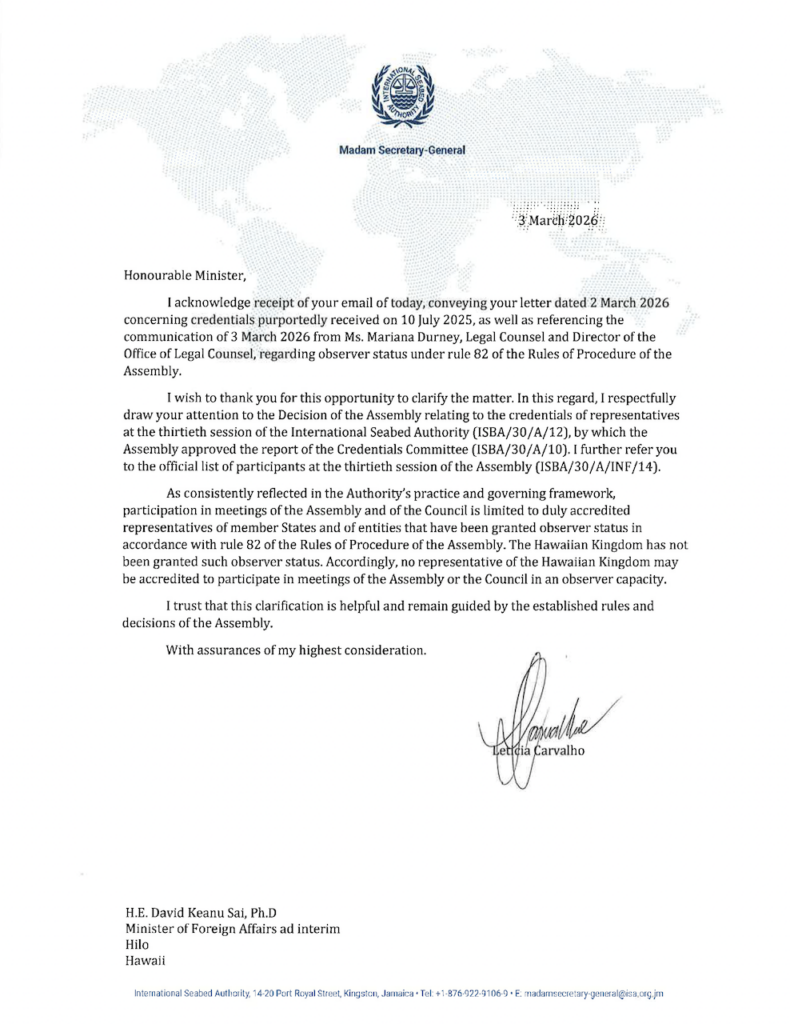
For the first time in its history, the United Nations General Assembly received a complaint from a Non-Member State of the United Nations. Today, August 14, 2025, the President of the UN General Assembly received the Hawaiian Kingdom’s Complaint of the United States of America’s unlawful and prolonged occupation of the Hawaiian Kingdom since January 17, 1893, and the commission of war crimes and human rights violations pursuant to Article 35(2) of the UN Charter. It has been the practice of States to submit formal complaints with the UN Security Council but not with the General Assembly. This is a first ever complaint to be received by the General Assembly under to Article 35(2).

Article 35(2) provides: “A state which is not a Member of the United Nations may bring to the attention of the Security Council or of the General Assembly any dispute to which it is a party if it accepts in advance, for the purposes of the dispute, the obligations of pacific settlement provided in the present Charter.”

While the Hawaiian Kingdom is a State under international law, it is a Non-Member State of the UN. While Switzerland is a State and a Member of the UN, it did not join the UN until 2002. Like Switzerland prior to 2002, the Hawaiian Kingdom is a Non-Member State. Article 35(2) addresses situations that endanger international peace and security. The 132-year American occupation of the Hawaiian Kingdom, the commission of war crimes, and the refusal of the State of Hawai‘i to transform into a Military Government meet this criterion.

Before the President can apply the UN procedure for complaints submitted by a Non-Member State under Article 35(2), he would need to first determine the legal status of the Hawaiian Kingdom, according to international law, to be a State who is not a Member of the UN. In anticipation of this query, Dr. David Keanu Sai, Minister of Foreign Affairs ad interim, in his letter to His Excellency Philomon Yang, President of the UN General Assembly, that enclosed the Hawaiian Kingdom Complaint, stated:

In the Larsen v. Hawaiian Kingdom at the Permanent Court of Arbitration (1999-2001), I served as Lead Agent for the Council of Regency representing the Hawaiian Kingdom. As such, I was in communication with the Permanent Court’s Principal Legal Counsel, Ms. Bette Shifman, whose responsibility was to determine whether the Hawaiian Kingdom exists as a State in continuity since the nineteenth century. This determination was necessary for the purpose of establishing the Permanent Court’s institutional jurisdiction in accordance with Article 47 of the 1907 Hague Convention for the Pacific Settlement of International Disputes. Article 47 provides, “The jurisdiction of the Permanent Court may, within the conditions laid down in the regulations, be extended to disputes between non-Contracting Powers or between Contracting Powers and non-Contracting Powers, if the parties are agreed on recourse to this Tribunal.” State continuity of the Hawaiian Kingdom is determined by the rules of customary international law.

Prior to the Permanent Court’s establishment of the arbitral tribunal on 9 June 2000, the Secretariat determined that the Hawaiian Kingdom had met the standing of a State and was thus, recognized as a non-Contracting Power. This fact is noted in Annex 2—Cases Conducted under the Auspices of the PCA or with the Cooperation of the International Bureau in the Permanent Court’s Annual Reports from 2000 to 2011. The Permanent Court also recognized the Council of Regency as the Hawaiian Kingdom’s government. I am enclosing a copy of Annex 2 from the 2011 Annual Report. It identifies Larsen v. Hawaiian Kingdom as the thirty-third case that came under the auspices of the Permanent Court. Since 2012, the Annual Reports no longer include Annex 2 because the Permanent Court’s website provides the list of cases, which includes Larsen v. Hawaiian Kingdom, Case no. 1999-01.

Under civilian law, the juridical fact, of the Hawaiian Kingdom’s existence as a State, produced the legal effect for the Secretariat to perform the juridical act of accepting the dispute, under the auspices of the Permanent Court, by virtue of Article 47. According to Professor Lenzerini, this juridical act “may be compared—mutatis mutandis—to a juridical act of a domestic judge recognizing a juridical fact (e.g. filiation) which is productive of certain legal effects arising from it according to law.” Since State members of the Permanent Court’s Administrative Council furnishes all Contracting States with an Annual Report, this represents “State practice [that] covers an act or statement by…State[s] from which views can be inferred about international law,” and it “can also include omissions and silence on the part of States.”

Since the United States and all Contracting States did not object to the Secretariat’s juridical act of acknowledging the Hawaiian Kingdom’s existence as a non-Contracting State, this reflects the practice of States—opinio juris. Furthermore, the Secretariat and the Administrative Council are treaty-based components of an intergovernmental organization comprised of representatives of States, and, therefore, “their practice is best regarded as the practice of States.” According to Professor Lenzerini, “it may be convincingly held that the PCA contracting parties actually agreed with the recognition of the juridical fact of the Hawaiian Kingdom as a State carried out by the International Bureau.”

Of the one hundred ninety-three Member States of the United Nations, one hundred twenty-three of these States are also Member States of the Permanent Court of Arbitration, to wit:

Albania, Argentina, Armenia, Australia, Austria, The Bahamas, Bahrain, Bangladesh, Belarus, Belgium, Belize, Benin, Brazil, Bulgaria, Burkina Faso, Cambodia, Cameroon, Canada, Chile, Colombia, the Democratic Republic of the Congo, Costa Rica, Croatia, Cuba, Cyprus, Czechia, the Democratic Republic of São Tomé and Príncipe, Denmark, Djibouti, Dominican Republic, Ecuador, Egypt, El Salvador, Eritrea, Estonia, Eswatini, Ethiopia, Fiji, Finland, France, Georgia, Germany, Greece, Guatemala, Guyana, Haiti, Honduras, Hungary, Iceland, India, Iran, Iraq, Ireland, Israel, Italy, Japan, Jordan, Kenya, Kuwait, Kyrgyzstan, Lao People’s Democratic Republic, Latvia, Lebanon, Libya, Lithuania, Liechtenstein, Lithuania, Luxembourg, Madagascar, Malaysia, Malta, Mauritius, Mexico, Mongolia, Montenegro, Morocco, Netherlands, New Zealand, Nicaragua, Nigeria, North Macedonia, Norway, Pakistan, Panama, Paraguay, the People’s Republic of China, Peru, Philippines, the Plurinational State of Bolivia, Poland, Portugal, Qatar, Romania, Republic of Korea, Russian Federation, Rwanda, Saudi Arabia, Senegal, Serbia, Singapore, Slovak Republic, Slovenia, South Africa, Spain, Sri Lanka, Sudan, Suriname, Sweden, Switzerland, Thailand, Timor-Leste, Togo, Türkiye, Uganda, Ukraine, United Arab Emirates, United Kingdom of Great Britain and Northern Ireland, United States of America, Uruguay, Vanuatu, Venezuela, Viet Nam, Zambia, and Zimbabwe. And Palestine, who is an Observer State, is also a Member State of the Permanent Court of Arbitration.

Hence, these States already recognized the Hawaiian Kingdom as a State and the Council of Regency as its Government by virtue of their membership, as Contracting States, of the Permanent Court of Arbitration. Of note Your Excellency, is that your country—Cameroon is not only a Successor State to the 1851 Treaty of Friendship, Commerce and Navigation between the Hawaiian Kingdom and Great Britain but also recognized the Hawaiian Kingdom and its Council of Regency as a Member State of the Permanent Court.

Minister Sai also brought to the attention of President Yang the identification of 154 Member States of the UN that currently have treaties with the Hawaiian Kingdom by virtue of international law. Minister Sai states:

The successor States of the Hawaiian Kingdom’s treaty partners, were not aware at the time of their independence, that the Hawaiian Kingdom continued to exist as a State, therefore, neither the newly independent States nor the Hawaiian Kingdom could declare “within a reasonable time after the attaining of independence, that the treaty is regarded as no longer in force between them.” Until there is a clarification of the successor States’ intentions, as to a common understanding with the Hawaiian Kingdom regarding the continuance in force of the Hawaiian treaty with their predecessor States, the Hawaiian Kingdom will presume the continuance in force of its treaties with the successor States. The majority of Member States of the United Nations are successor States to treaties with the Hawaiian Kingdom.

This position, taken by the Hawaiian Kingdom, is consistent with the 1978 Vienna Convention on Succession of States in respect of Treaties. Article 24 states:

1. A bilateral treaty which at the date of the succession of States was in force in respect of the territory to which the succession of States relates is considered as being in force between a newly independent State and the other State party when:
a. they expressly so agree; or
b. by reason of their conduct they are to be considered as having agreed.
2. A treaty considered as being in force under paragraph 1 applies in the relations between the newly independent State and the other State party from the date of the succession of States, unless a different intention appears from their agreement or is otherwise established.

Since successor States, which include Member States of the United Nations, were unaware of the existence of the Hawaiian Kingdom at the time of their independence, and its treaties with their predecessor States, Article 24(1)(a) and (b) could not arise. Therefore, under customary international law, in the absence of an express agreement or an agreement by conduct, the Hawaiian Kingdom will presume that its treaties continue in force, for two years from the receipt of this communication, with the successor States. Here follows the list of successor States to Hawaiian Kingdom treaties:

1875 Treaty of Friendship, Commerce and Navigation between the Hawaiian Kingdom and the Austro-Hungarian Empire—Austria and Hungary.

1862 Treaty of Amity, Commerce and Navigation between the Hawaiian Kingdom and Belgium—Burundi, Congo, Democratic Republic of the Congo, and Rwanda.

1857 Treaty of Friendship, Commerce and Navigation between the Hawaiian Kingdom and France—Algeria, Benin, Burkina Faso, Cambodia, Cameroon, Central African Republic, Chad, Comoros, Côte d’Ivoire, Djibouti, Gabon, Guinea, Lao People’s Democratic Republic, Lebanon, Madagascar, Mali, Mauritania, Morocco, Niger, Senegal, Syrian Arab Republic, Togo, Tunisia, Vanuatu, and Viet Nam.

1851 Treaty of Friendship, Commerce and Navigation between the Hawaiian Kingdom and Great Britain—Afghanistan, Antigua and Barbuda, Australia, The Bahamas, Bahrain, Bangladesh, Barbados, Belize, Bhutan, Botswana, Brunei Darussalam, Cameroon, Canada, Cyprus, Egypt, Eswatini, Fiji, Gambia, Ghana, Grenada, Guyana, India, Iraq, Ireland, Israel, Jamaica, Jordan, Kenya, Kiribati, Kuwait, Lesotho, Malawi, Malaysia, Maldives, Malta, Mauritius, Myanmar, Namibia, Nauru, Nepal, New Zealand, Nigeria, Pakistan, Papua New Guinea, Qatar, Saint Kitts and Nevis, Saint Lucia, Saint Vincent and the Grenadines, Samoa, Seychelles, Sierra Leone, Singapore, Solomon Islands, Somalia, South Africa, South Sudan, Sri Lanka, Sudan, Tonga, Trinidad and Tobago, Tuvalu, Uganda, United Arab Emirates, United Republic of Tanzania, Vanuatu, Yemen, Zambia, and Zimbabwe.

1863 Treaty of Amity, Commerce and Navigation between the Hawaiian Kingdom and Italy—Libya and Somalia.

1871 Treaty of Amity and Commerce between the Hawaiian Kingdom and Japan—Democratic People’s Republic of Korea and the Republic of Korea.

1862 Treaty of Friendship, Commerce and Navigation between the Hawaiian Kingdom and the Netherlands—Indonesia and Suriname.

1882 Treaty between the Hawaiian Kingdom and Portugal—Angola, Cabo Verde, Guinea-Bissau, Mozambique, Sao Tome and Principe, and Timor-Leste.

1869 Treaty of Commerce and Navigation between the Hawaiian Kingdom and Russia—Armenia, Azerbaijan, Belarus, Bosnia and Herzegovina, Croatia, Estonia, Georgia, Kazakhstan, Kyrgyzstan, Latvia, Lithuania, Mongolia, Montenegro, North Macedonia, Republic of Moldova, Slovenia, Tajikistan, Turkmenistan, Ukraine, and Uzbekistan.

1863 Treaty of Peace and Friendship between the Hawaiian Kingdom and Spain—Cuba and Equatorial Guinea.

1852 Treaty of Friendship, Commerce and Navigation between the Hawaiian Kingdom and the Kingdoms of Sweden and Norway—Norway and Sweden.

1849 Treaty of Friendship, Commerce and Navigation between the Hawaiian Kingdom and the United States—Marshall Islands, Micronesia, Palau, Philippines.

The Hawaiian Kingdom has treaties with one hundred fifty-four Member States of the United Nations, of which fourteen treaties are with the original States, and one hundred forty treaties are with the successor States.

According to the UN complaint procedure, when the President of the General Assembly receives a formal complaint by a State, whether a Member of the UN or not, he will assess the complaint based on the rules of procedure and the established practices of the General Assembly. Because there is no practice to follow by the President, given this is the first time a complaint has been submitted to the General Assembly by a State under Article 35(2), he will have to be guided by what the Hawaiian Kingdom is seeking in its complaint.

The Hawaiian Kingdom is not seeking to resolve a dispute but is rather bringing to the attention of the General Assembly the situation in the Hawaiian Kingdom so that it can take certain actions to address the situation of an unlawful and prolonged occupation of a State under international law. What the Hawaiian Kingdom requests of the General Assembly is clearly stated in paragraph 2.3 of the Complaint.

The Hawaiian Kingdom herein files this Complaint as a Non-Member State, pursuant to Article 35(2) of the United Nations Charter, for the violation of treaties and international law and calls upon the United Nations General Assembly:

1. To ensure the United States of America complies with international humanitarian law and the law of occupation;

2. To ensure that the United States of America establishes a military government, by its State of Hawai‘i, to administer the laws of the Hawaiian Kingdom as it stood before the American invasion and unlawful seizure of the Hawaiian Government on 17 January 1893, and the provisional laws, proclaimed by the Council of Regency on 10 October 2014, that bring Hawaiian Kingdom laws to the current state; and

3. To ensure that all Member States of the United Nations shall not recognize as lawful the United States of America’s presence and authority within the territory of the Hawaiian Kingdom, except for its temporary and limited authority vested under the law of occupation.

The Hawaiian Kingdom’s third request does not require collective action to be taken by the General Assembly. The individual Member States of the General Assembly would be obligated to take individual action themselves regarding the Hawaiian situation once they have been made aware of the Hawaiian situation by the Complaint.

Under Article 41(2) of the UN Responsibility of States for Internationally Wrongful Acts committed by the United States against the Hawaiian Kingdom, “No State shall recognize as lawful a situation created by a serious breach within the meaning of article 40, nor render aid or assistance in maintaining that situation.” Article 40 provides, “This chapter applies to the international responsibility which is entailed by a serious breach by a State of an obligation arising under a peremptory norm of general international law.”

Since the prolonged occupation and the commission of war crimes is a serious breach of peremptory norms of general international law, Article 41(2) is triggered once a State is made aware of the Hawaiian situation by the Complaint. As such, States are obligated to take individual action on the Hawaiian Kingdom’s third request to “not recognize as lawful the United States of America’s presence and authority within the territory of the Hawaiian Kingdom, except for its temporary and limited authority vested under the law of occupation.” A General Assembly resolution is not required for a State to immediately act.

According to Minister Sai, “The contents of my letter to President Yang and the information provided in the complaint reflects the tedious work of the Council of Regency in carrying out its strategic plan to address the prolonged occupation of the country. The State of Hawai‘i now finds itself at a cross road to begin to comply with the law of occupation by establishing a Military Government according to the Council of Regency’s Operational Plan or face prosecution for war crimes. The State of Hawai‘i’s deliberate failure has not only provided the evidential basis for submitting the complaint as a Non-Member State of the United Nations, but to bring international attention to our situation.”

Minister Sai also stated, “Oxford University Press’ recent publication of my chapter “Hawai‘i’s Sovereignty and Survival in the Age of Empire,” in the 2024 book Unconquered States: Non-European Powers in the Imperial Age, has opened many doors for the Council of Regency that were not opened before. As the entire world is watching our history in Chief of War on Apple TV, they will now know our true history that followed those epic battles of Kamehameha I when we became a British Protectorate in 1794, Kamehameha’s consolidation of the island kingdoms into the Hawaiian Kingdom in 1810, transforming into a constitutional monarchy in 1840, becoming a sovereign and independent State in 1843, and its continued existence as a State under international law despite the prolonged American occupation since our country was invaded by U.S. Marines in 1893. To use the idiom for the filing of the UN Complaint, ‘We must strike when the iron is hot!'”

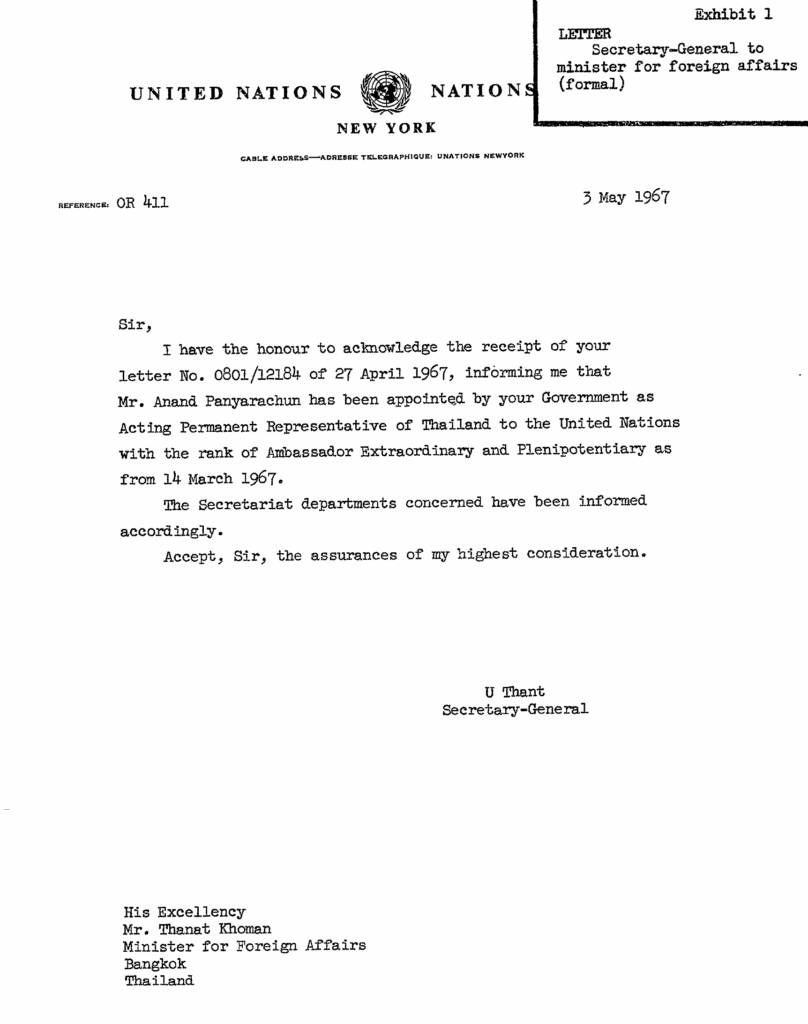
Dr. Keanu Sai is Interviewed on Minneapolis/Saint Paul FOX 9 “The Afternoon Shift” on the Annexation of Hawai‘i

Professor Jonathan Osorio, Dean of the University of Hawai‘i at Mānoa’s Hawai‘inuiakea School of Hawaiian Knowledge, was contacted by the host of The Afternoon Shift on FOX 9 Minneapolis/Saint Paul if he or his colleagues from the university could be on his show to talk about the joint resolution of the annexation Hawai‘i that was signed in law on July 7, 1898.

Professor Osorio responded by stating, “I am copying two professors from UH, Kamana Beamer and Keanu Sai who might be interested. But you should be aware that Hawaiʻi was never annexed by the US. Both these scholars can attest to that.” Dr. Keanu Sai was able to do the interview.

BREAKING NEWS: MPD Detective calls upon Lieutenant Colonel Rosner of the Hawai‘i Army National Guard to comply with the Law of Occupation

NEWS RELEASE

FOR IMMEDIATE RELEASE July 7, 2025

HONOLULU, Hawaiian Kingdom—Press release from the office of Edward Halealoha Ayau. On July 7, 2025, Ayau, on behalf of his client Maui Police Detective Kamuela Lanakila Mawae, sent a letter to Lieutenant Colonel (LTC) Michael Rosner of the Hawai‘i Army National Guard explaining the circumstances of his client’s concern that he may be criminally culpable for war crimes.

To download Ayau’s letter to LTC Rosner go to this link.

In the letter Ayau stated, “On June 3, 2025, I personally went to Attorney General Anne Lopez’s office in Honolulu to deliver a letter, on behalf of my client, explaining the circumstances of my client’s concern that he may be criminally culpable for war crimes by enforcing American laws in the County of Maui, which I am attaching.” He requested for the Attorney General “to make public a legal opinion that was formally requested by Senator Cross Makani Crabbe by letter dated September 19, 2024, pursuant HRS §28-3,” by June 11, 2025.

Ayau stated, “June 11th has passed, and the Attorney General has yet to make public that legal opinion providing rebuttable evidence that the Hawaiian Kingdom does not exist and that war crimes are not being committed. For you and all officials and employees of the State of Hawai‘i and the Counties, the significance of her failure to provide a legal opinion is an acknowledgment that Hawai‘i is an occupied State and not the State of Hawai‘i, and that war crimes are being committed. The Attorney General is the highest-ranking law officer of the State of Hawai‘i and her failure to provide a legal opinion that the State of Hawai‘i is within the territory of the United States and not within the territory of the Hawaiian Kingdom is a dereliction of her duty she owes to all officials and employees of the State of Hawai‘i and the Counties.”

Ayau goes on to state, “This is very concerning for my client because he is not only a law enforcement officer and employee of the County of Maui, but he is also the Vice-Chair of the Maui Chapter of the State of Hawai‘i Organization of Police Officers Union (SHOPO). Also affected by the dereliction of the Attorney General are SHOPO’s collective bargaining agreements. Because collective bargaining agreements are governed by Federal and State of Hawai‘i statutes, administrative agency regulations, and American judicial decisions, which all constitutes the war crime of usurpation of sovereignty, the silence by the Attorney General is a recognition that our collective agreements are void because they are a product of war crimes.”

Ayau apprised LTC Rosner of the work of the Royal Commission of Inquiry (RCI) that was established in 2019 to investigate war crimes in the occupied Hawaiian Kingdom. Ayau stated, “The Royal Commission of Inquiry has already published 26 War Criminal Reports since 2002 of State of Hawai‘i officials. Of significance, these officials include Governors David Ige and Josh Green, Mayors Derek Kawakami, Mitchell Roth, and Michael Victorino, and Supreme Court Justices Mark Recktenwald, Paula Nakayama, Sabrina McKenna, Richard Pollack, Michael Wilson and Todd Eddins. The Attorney General is also the subject of a war criminal report.”

Ayau also cited a very favorable book review, by Professor Anita Budziszewska from the University of Warsaw, of the Commission’s 2020 eBook “The Royal Commission of Inquiry: Investigating War Crimes and Human Rights Violations Committed in the Hawaiian Kingdom” that was published in the Polish Journal of Political Science in 2022. He stated, “It would clearly appear that the authority of the Royal Commission of Inquiry, established by the Council of Regency in 2019 with its mandate to investigate war crimes and human rights violations, is a legitimate commission of inquiry and whose reports, that have been published on its website, would serve as the evidential basis for prosecution of war criminals.” Ayau then states, “The Attorney General is up against a wall of law and evidence that renders the State of Hawai‘i and its Counties, established by American law, as unlawful and the product of the war crime of usurpation of sovereignty during military occupation.”

Ayau then cites Dr. Keanu Sai, who is head of the RCI, that sent LTC Rosner a letter explaining the circumstances that led to his military duty to transform the State of Hawai‘i into a Military Government. Dr. Sai wrote, “It is now over a year since the Hawai‘i Army National Guard’s leadership became aware that the war crime of usurpation of sovereignty during military occupation is being committed and that its their duty to put a stop to it by establishing a military government in accordance with U.S. Department of Defense Directive 5100.1, U.S. Army Field Manual 6-27—chapter 6, and the law of occupation. Major General Kenneth Hara’s willful failure to obey Army regulations, and resulting his dereliction of duty, has led to war criminal reports for the war crime by omission on himself, Brigadier General Stephen Logan, Colonel Wesley Kawakami, Lieutenant Colonel Fredrick Werner, Bingham Tuisamatatele, Jr., Lieutenant Colonel Joshua Jacobs, and Lieutenant Colonel Dale Balsis. As a result, you are, now, the most senior officer in the Army National Guard.”

Ayau refers to the Council of Regency’s 2023 Operational Plan for Transitioning the State of Hawai‘i into a Military Government that would guide LTC Rosner in his performance of his military duty. On the Military Government of Hawai‘i, Ayau states, “It is my understanding of the Operational Plan that by transforming the State of Hawai‘i into a Military Government, you, as the American Theater Commander, will be replacing Governor Josh Green with yourself as Military Governor just as General Douglas MacArthur replaced the head of the Japanese civilian government as Military Governor of the Occupied State of Japan in 1945. Like Japan, all officials and employees would continue to exist except for the State of Hawai‘i Legislature and the County Councils, which have been enacting American laws in violation of the law of occupation.”

“When you perform your duty,” Ayau states, “law enforcement officers, especially those of Hawaiian ancestry, would greatly benefit from their rights under Hawaiian Kingdom laws.” Ayau then refers to Dr. Sai’s statement of some of those benefits.”

Section 67. The following persons shall be exempt from all internal taxes: His Majesty the King; the Diplomatic Agents of Foreign Countries and their Attaches duly made know to the Department of Foreign Affairs. The following persons shall be exempt from personal taxes: All clergymen of any Christian denomination regularly engaged in their vocation; all teachers of youth employed in public or private schools for more than six months of the year; all soldiers in actual service and all volunteer soldiers duly enrolled and actually doing duty. Act to Consolidate and Amend the Law Relating to Internal Taxes (1883); 1884 Compiled Laws, p. 131.

4. That a certain portion of the government lands in each island shall be set apart, and placed in the hands of special agents, to be disposed of in lots of from one to fifty acres, in fee-simple, to such natives as may not be otherwise furnished with sufficient land, at a minimum price of fifty cents per acre. An Act Confirming Certain Resolutions of the King and Privy Council, passed on the 21st day of December, A.D. 1849, Granting to the Common People Allodial Titles for Their Own Lands and House Lots, and Certain Other Privileges (1850), also known as the Kuleana Act. According to the inflation calculator, $.50 in 1893 is equivalent in purchasing power to $17.77 in 2025.

Queen’s Hospital was established “for relief of indigent, sick, and disabled people of the Hawaiian Kingdom; as well as of such foreigners, and others, as may desire to avail themselves of the same.” Charter of Queen’s Hospital (1859) established by virtue of An Act to Provide Hospitals for the Relief of Hawaiians in the City of Honolulu and other Localities (1859).

“The Queen’s Hospital is, from the nature of its character, a quasi-public institution. When it was chartered it was provided that all Hawaiians, of native birth, should be treated free of charge. Foreigners were to be treated by payment of fees.” George W. Smith, a Trustee of the Queen’s Hospital wrote in an editorial, Honolulu Advertiser (1900a:2).

The 1886 budget provided $12,000 for the Queen’s Hospital. According to the Charter, the Queen’s Hospital would match those funds. According to the inflation calculator, $12,000.00 in 1886 is equivalent in purchasing power to $408,254.04 in 2025. Queen’s Hospital’s annual budget in 1886 was $816,508.08.

There is no right to bear arms in the Hawaiian Kingdom, which has similar gun laws like Japan. “2. The following persons are hereby declared to be authorized to bear arms, viz: All persons holding official, military or naval rank, either under this government, or that of any nation at peace with this kingdom, when worn for legitimate purposes. Penal Code, Chapter LIV—To Prevent the Carrying of Deadly Weapons (1869). Hawaiian law also provides for yearly licensing of firearms for hunting. Assault weapons are not hunting weapons.

Free trade with foreign countries not impeded by the American Jones Act, formally known as the Merchant Marine Act of 1920. Under the Jones Act, foreign goods and products destined for Hawai‘i had to offload from foreign ships at designated American ports on the west coast, and then reloaded on ships destined for Hawai‘i. Under free trade, as the Hawaiian Kingdom had before American invasion and occupation, Hawaiian ports would be open for foreign goods and products to be off loaded directly and then continue to ports of the United States.

According to customary international law, the Hawaiian Kingdom not only has treaties with Austria, Belgium, Bremen, Denmark, France, Germany, Hamburg, Hungary, Italy, Japan, Luxembourg, Netherlands, Norway, Portugal, Russia, Spain, Switzerland, Sweden, the United Kingdom and the United States, but also with their successor States. Of the 193 Member States of the United Nations, the Hawaiian Kingdom has treaties with 154 of its Member States.

The Hawaiian Kingdom is also a recognized neutral State like Switzerland. As a neutral State, international laws protects its territorial integrity and independence. The territory of states whose neutrality is permanent is inviolable and gives rise to its neutral rights that its territory cannot be violated by belligerents. This neutral right proscribes belligerents from moving their troops across neutral territory or using neutral territory for belligerent purposes. These prohibitions have been codified under articles 2 through 4 of the 1907 Hague Convention V.

Under the provisional laws of the Hawaiian Kingdom taxes for the State of Hawai‘i and the Counties would continue so that government service can be maintained. Tax collection by the Internal Revenue Service, however, would cease to be collected in Hawai‘i because these taxes are for American government services.

“The Attorney General’s dereliction of her duty to protect all officials and employees of the State of Hawai‘i and the Counties, to include my client,” Ayau states, “has now compelled him to not only continue to perform his duties as a police officer under the laws of 1893 and the provisional laws of the Hawaiian Kingdom, but to also call for the lawful transformation of the State of Hawai‘i into a Military Government according to the Council of Regency’s Operational Plan. It is your military duty, as the most senior commander in the Hawai‘i Army National Guard, to immediately transform the State of Hawai‘i into a Military Government in accordance with international humanitarian law, the law of occupation, U.S. Department of Defense Directive 5100.01, and Army regulations, so that the war crime of usurpation of sovereignty during military occupation would cease and that Hawaiian Kingdom laws, together with the provisional laws, will be administered.”

Ayau closes his letter by citing a Hawaiian Kingdom Supreme Court case in 1847, Shillaber v. Waldo, on the court’s view of the rule of law and its tie to the Hawaiian Kingdom’s coat of arms. The Supreme Court stated, “For I trust that the maxim of this Court ever has been, and ever will be, that which is so beautifully expressed in the Hawaiian coat of arms, namely, ‘The life of the land is preserved by righteousness.’ We know of no other rule to guide us in the decision of questions of this kind, than the supreme law of the land, and to this we bow with reverence and veneration, even though the stroke fall on our own head. In the language of another, ‘Let justice be done though the heavens fall.’ Let the laws be obeyed, though it ruin every judicial and executive officer in the Kingdom. Courts may err. Clerks may err. Marshals may err—they do err in every land daily; but when they err let them correct their errors without consulting pride, expediency, or any other consequence.”

In his email to LTC Rosner, Ayau wrote, “I strongly yet respectfully urge a careful read and discussions with Lt Col Lloyd Phelps, the Staff Judge Advocate of the U.S. Army National Guard in Hawai‘i.”

Contact: Edward Halealoha Ayau, Esq.
Attorney for Maui Detective Kamuela Lanakila Mawae
(808) 646-9015
halealohahapai64@gmail.com

###

BREAKING NEWS: Hawai‘i Attorney General Acknowledges Hawai‘i is Occupied and that War Crimes are being Committed

NEWS RELEASE

FOR IMMEDIATE RELEASE June 12, 2025

HONOLULU, Hawaiian Kingdom—Press release from the office of Edward Halealoha Ayau. On June 3, 2025, attorney Edward Halealoha Ayau, on behalf of his client Maui Police Detective Kamuela Lanakila Mawae, hand delivered a 10-page letter to State of Hawai‘i Attorney General Anne Lopez. That letter addresses legal concerns regarding the status of Hawai‘i as an occupied State and potential war crimes being committed by law enforcement officers.

To download Ayau’s letter to the Attorney General go to this link.

In the letter, Ayau stated, “on behalf of my client, I am respectfully submitting to you a deadline by June 11, 2025, for you to make public the legal opinion, as formally requested by former Senator Crabbe, that clearly states, by citing sources of international law, i.e. treaties, custom, general principles of law, and judicial decisions and scholarly writings, that the State of Hawai‘i is within the territory of the United States and not within the territory of the Kingdom.” He also stated that if “you do not make public your legal opinion by this day, my client will be forced to comply with the law of occupation.”

As of today, Lopez did not make public a legal opinion as requested by former Senator Crabbe. According to Ayau, “the significance of Lopez’s failure to provide a legal opinion that was formally requested back in September of 2024 is an acknowledgment that Hawai‘i is an occupied State and not the State of Hawai‘i, and that war crimes are being committed.”

In his letter to Lopez, Ayau referenced Judge James Crawford of the International Court of Justice who stated, there “is a presumption that the State continues to exist, with its rights and obligations…despite a period in which there is no, or no effective, government,” and he goes on to state that military occupation “does not affect the continuity of the State, even where there exists no government claiming to represent the occupied State.”

Ayau also referenced Professor Matthew Craven, an international law scholar from the University of London (SOAS) that wrote a legal opinion on the Hawaiian Kingdom’s continued existence as a State under international law. Craven wrote, “If one were to speak about a presumption of continuity, one would suppose that an obligation would lie upon the party opposing that continuity to establish the facts substantiating its rebuttal. The continuity of the Hawaiian Kingdom, in other words, may be refuted only by reference to a valid demonstration of legal title, or sovereignty, on the part of the United States, absent of which the presumption remains.” 

Ayau also referenced renowned expert and scholar, Professor William Schabas from Middlesex University London, who authored a legal opinion for the Royal Commission of Inquiry identifying war crimes being committed since January 17, 1893. One of those war crimes is the unlawful imposition of American laws and administrative measures within the territory of an occupied State, which is called the war crime of usurpation of sovereignty during military occupation.

Ayau stated in his letter, “If you do not make public your legal opinion by this day, my client will be forced to comply with the law of occupation where the Maui Police Department will continue to exist under the provisional laws of the Hawaiian Kingdom that was proclaimed by the Council of Regency in 2014 because it does “not run contrary to the express, reason and spirit of the laws of the Hawaiian Kingdom,” which is explained on page 222 of the Council of Regency’s operational plan to transition the State of Hawai‘i into a Military Government, which I am attaching.”

Ayau further stated, “My client while continuing to perform his duties as a police officer, will call for the lawful transformation of the State of Hawai‘i into a Military Government according to the Council of Regency’s operational plan. It is the legal duty of Lieutenant Colonel Michael Rosner, who is the most senior commander in the Hawai‘i Army National Guard, to immediately transform the State of Hawai‘i into a Military Government in accordance with international humanitarian law, the law of occupation, U.S. Department of Defense Directive 5100.01, and Army regulations, so that the war crime of usurpation of sovereignty during military occupation would cease and that Hawaiian Kingdom laws, together with the provisional laws, will be administered. Lieutenant Colonel Lloyd Phelps is the Army National Guard’s Staff Judge Advocate to advise LTC Rosner of his military duties as the theater commander of the Occupied State of the Hawaiian Kingdom.”

Ayau also stated in his letter that Native Hawaiians, irrespective of blood quantum, comprise the majority of the citizenry of the Hawaiian Kingdom. He stated that as aboriginal Hawaiian subjects they have certain rights under Hawaiian Kingdom law.

Under Hawaiian Kingdom laws, aboriginal Hawaiian subjects are the recipients of free health care at Queen’s Hospital and its outlets across the islands. In its budget, the Hawaiian Legislative  Assembly would allocate money to the Queen’s Hospital for the healthcare of aboriginal Hawaiian subjects. The United States stopped allocating monies from its Territory of Hawai‘i Legislature in 1909. Aboriginal Hawaiian subjects are also able to acquire up to 50-acres of public lands at $20.00 per acre under the 1850 Kuleana Act.

The greatest dilemma for aboriginal Hawaiians today is having a home and health care. The average cost of a home today is $820,000.00. And health care insurance for a family of 4 is at $1,500 a month. According to the Office of Hawaiian Affairs’ Native Hawaiian Health Fact Sheet 2017, “Today, Native Hawaiians are perhaps the single racial group with the highest health risk in the State of Hawai‘i. This risk stems from high economic and cultural stress, lifestyle and risk behaviors, and late or lack of access to health care.”

Ayau says, “The denial of Native Hawaiian rights under kingdom law for over a century can no longer be tolerated, and compliance with international law and the law of occupation will correct this international crime.”

Contact: Edward Halealoha Ayau, Esq.
Attorney for Maui Detective
Kamuela Lanakila Mawae
(808) 646-9015
halealohahapai64@gmail.com

###