
Hawaiian Kingdom files Additional Evidence from the International Seabed Authority of its Legal Standing as a Government in the Kamehameha Schools Federal Lawsuit

On January 23, 2026, U.S. District Judge Micah Smith issue an order denying the Council of Regency of the Hawaiian Kingdom’s Motion to Intervene in the federal lawsuit Students for Fair Admissions v. Kamehameha Schools. The Council of Regency is intervening as the government of the Hawaiian Kingdom.

The lawsuit, brought by Students for Fair Admissions (SFFA), seeks to dismantle the Native Hawaiian admissions policy of Kamehameha Schools—an institution created by Aliʻi Bernice Pauahi Bishop to uplift and educate Hawaiian children. SFFA claims that Kamehameha Schools’ policy violates U.S. civil rights law and is premised on the assertion that Hawaiʻi was lawfully annexed and fully absorbed into the United States more than a century ago.

The Council of Regency’s intervention is necessary because this case is built on fundamental historical and legal inaccuracies that neither party before the Court can correct. At stake is not only the future of Kamehameha Schools, but the integrity of Hawaiian Kingdom law, the rights of the Hawaiian people, and the protection of future generations who were the express beneficiaries of Pauahi’s trust.

U.S. civil rights law, which includes all U.S. laws and administrative measures, cannot be imposed within the territory of the occupied Hawaiian Kingdom, which constitutes the war crime of usurpation of sovereignty during military occupation. The United States has recognized usurpation of sovereignty during military occupation as a war crime since the First World War.

As an occupied State, only Hawaiian Kingdom law applies in this case, which allows preferential admissions to Hawaiian children. The Council of Regency is intervening to protect Kamehameha Schools, which was called the Bishop Estate in the nineteenth century.

Kamehameha Schools was created under the laws of the Hawaiian Kingdom in the nineteenth century, at a time when Hawaiʻi was an internationally recognized sovereign State with treaties, diplomats, and a functioning constitutional government. Pauahi’s will was accepted by the Hawaiian Kingdom probate court in 1885—years before the illegal overthrow of the government of Queen Liliʻuokalani on January 17, 1893. Those laws did not disappear with the arrival of U.S. troops.

Under international law, the overthrow of a government does not extinguish the State itself. In 1997, the government of the Hawaiian Kingdom was restored as a Regency under Hawaiian constitutional law and the legal doctrine of necessity.

On February 3, 2026, the Council of Regency, as interim government of the Hawaiian Kingdom, filed its Motion for Reconsideration with the United States District Court for the District of Hawai‘i, seeking reconsideration of Judge Smith’s order denying the Hawaiian Kingdom’s Motion to Intervene in the federal lawsuit filed on January 21, 2026.

The Hawaiian Kingdom argues that Judge Smith committed “manifest errors of law” including its misapplication of the political question doctrine at the intervention stage. The political question doctrine bars federal courts from adjudicating disputes that are “textually committed” by the U.S. Constitution to another branch or lack judicially manageable standards to resolve. In the case of Hawai‘i, the court invoked this doctrine because it falsely asserted that the United States executive branch has not recognized the Hawaiian Kingdom. In this case, the Hawaiian Kingdom provides conclusive evidence that Judge Smith’s order is a “manifest error.”

In its motion for reconsideration, the Council of Regency provided two explicit evidence that the United States recognized the continued existence of the Hawaiian Kingdom as a State and the Council of Regency as its interim government during international arbitration proceedings at the Permanent Court. The first piece of evidence is when the United States entered into an executive agreement with the Council of Regency, called the 2000 Sai-Clinton agreement, for it to have access to all records and pleadings of the international arbitration case of Larsen v. Hawaiian Kingdom at the Permanent Court of Arbitration from 1999-2001.

The second piece of evidence is under opinio juris—customary international law, when it did not object to the Permanent Court’s recognition of the Hawaiian Kingdom and the Council of Regency before it formed the arbitration tribunal on June 9, 2000. By not objecting, the United States accepted the Permanent Court’s recognition of the Hawaiian Kingdom and the Council of Regency. Here is a link to a memorandum that explains the circumstances of this evidence under international law published by the Hawaiian Kingdom’s Foreign Ministry.

On the matter of opinio juris—customary international law, none of the current 127 Contracting States to the treaty that formed the Permanent Court, to include the United States, objected to the Permanent Court’s conclusion that the Hawaiian Kingdom continues to exist and that it is a non-Contracting State under Article 47 of the treaty permitting the Hawaiian Kingdom access to the Permanent Court. Article 47 states, the “jurisdiction of the Permanent Court may…be extended to disputes [with] non-Contracting Powers.” In international law, “Powers” is used interchangeably with “States.”

Under opinio juris, the practice of the Permanent Court includes its case description on its website that was not objected to by the United States. It states:

Lance Paul Larsen, a resident of Hawaii, brought a claim against the Hawaiian Kingdom by its Council of Regency (“Hawaiian Kingdom”) on the grounds that the Government of the Hawaiian Kingdom is in continual violation of: (a) its 1849 Treaty of Friendship, Commerce and Navigation with the United States of America, as well as the principles of international law laid down in the Vienna Convention on the Law of Treaties, 1969 and (b) the principles of international comity, for allowing the unlawful imposition of American municipal laws over the claimant’s person within the territorial jurisdiction of the Hawaiian Kingdom.

The case description by the Permanent Court states that the Council of Regency is the government of the Hawaiian Kingdom. The 1849 Treaty of Friendship, Commerce and Navigation with the United States of America continues to exist, and the imposition of American laws within Hawaiian territory is “unlawful.”

On February 16, 2026, the Hawaiian Kingdom filed its motion for leave to file supplemental brief in support of motion for reconsideration that provided additional evidence of the Council of Regency being the interim government of the Hawaiian Kingdom.

Added to the Permanent Court, is the recognition of the Hawaiian Kingdom by the International Seabed Authority (ISA). In a formal letter, dated March 3, 2026, from the ISA’s Secretary General, Letitia Carvalho, to Hawaiian Kingdom Minister of Foreign Affairs ad interim, Dr. David Keanu Sai, Ph.D., the ISA recognized the continued existence of the Hawaiian Kingdom as a State since the nineteenth century and its status as an Observer State. In her letter, the Secretary General clarifies the rules and practice of the ISA for a State to acquire observer status under Rule 82 of the Rules of Procedure of the Assembly of the ISA.

The ISA is an international organization that is composed of representatives of States that are Contracting States to the 1982 United Nations Convention on the Law of the Sea (UNCLOS). The headquarters of the ISA is in Kingston, Jamaica, where the Council and the Assembly of the ISA meet in session. Currently, the membership of the ISA is comprised of the European Union and 171 Contracting States to the UNCLOS.

According to Civil Beat, “Leticia Carvalho, the secretary-general of the ISA, said last week that she wants to finalize global rules governing seabed mining by the end of this year, a reversal of her previous position that the regulations could take several years to finalize, in part a reaction to President Donald Trump’s aggressive push to mine both U.S. and international waters outside the international regulatory framework.” 

On March 5, 2026, Minister Dr. Sai provided a formal letter to the Secretary General acknowledging receipt of her letter, as requested, and thanking her for the ISA’s recognition of the continued existence of the Hawaiian Kingdom as a State since the nineteenth century and the Council of Regency as its interim government.

On March 10, the Council of Regency filed a Motion for Leave to file Letters Supplement in Support of Motion for Reconsideration. These letters from the ISA Secretary General and the Hawaiian Kingdom’s Minister of Foreign Affairs affirm the legal standing of the Council of Regency as the government of the Hawaiian Kingdom, which is at the core of the Hawaiian Kingdom’s Motion for Reconsideration. The legal standing of the Hawaiian Kingdom and the Council of Regency, as its interim government, prevents Judge Smith from invoking the political question doctrine.
Neutrality Studies Podcast: From the Ocean to the Sea, Hawaii will be Free | Dr. Keanu Sai

Dr. Keanu Sai was again invited to do a podcast interview by Professor Pascal Lottaz on the subject of the American occupation of the Hawaiian Kingdom, a Neutral State. Professor Lottaz is an Assistant Professor for Neutrality Studies at the Waseda Institute for Advanced Study in Tokyo. He is a also a researcher at Neutrality Studies, where its YouTube channel, which airs their podcasts, has 153,000 subscribers worldwide.

The first podcast was titled “EX-Army Officer WAGES LAWFARE To End Illegal Occupation of Hawaii” that was posted December 5, 2024.

BREAKING NEWS: International Seabed Authority Recognizes the Hawaiian Kingdom

FOR IMMEDIATE RELEASE
March 10, 2026:

In a formal letter, dated March 3, 2026, from the International Seabed Authority’s (ISA) Secretary General, Letitia Carvalho, to Hawaiian Kingdom Minister of Foreign Affairs ad interim, Dr. David Keanu Sai, Ph.D., the ISA recognized the continued existence of the Hawaiian Kingdom as a State since the nineteenth century and its status as an Observer State. In her letter, the Secretary General clarifies the rules and practice of the ISA for a State to acquire observer status under Rule 82 of the Rules of Procedure of the Assembly of the ISA.

The ISA is an international organization that is composed of representatives of States that are Contracting States to the 1982 United Nations Convention on the Law of the Sea (UNCLOS). The headquarters of the ISA is in Kingston, Jamaica, where the Council and the Assembly of the ISA meet in session. Currently, the membership of the ISA is comprised of the European Union and 171 Contracting States to the UNCLOS.

According to its website, the “ISA is the organization through which States Parties to UNCLOS organize and control all mineral-resources-related activities in the Area for the benefit of humankind as a whole. In so doing, ISA has the mandate to ensure the effective protection of the marine environment from harmful effects that may arise from deep-seabed-related activities.”

For those States that have not acceded to the UNCLOS, participation is allowed if the States are granted observer status. While the Observer State is permitted to participate in the meetings, it has no voting rights. There are currently 27 Observer States that includes the United States.

Rule 82(a) of the Rules of Procedure of the Assembly provides “States and entities referred to in article 305 of the United Nations Convention on the Law of the Sea which are not members of the Authority,” can participate as Observers. Article 305(a) of the UNCLOS provides “all States” can become a Contracting State to the Convention. Though it is not yet a Contracting State and member to the UNCLOS pursuant to Article 305(a) of the Convention, the Hawaiian Kingdom has been acknowledged by the ISA as a State, as referred to in article 305 of the UNCLOS, and is consequently qualified to apply for participation as an “Observer” in meetings of the Assembly and of the Council of the ISA.

Since June of 2025, Minister Dr. Sai, in his official capacity as Minister of Foreign Affairs ad interim of the Hawaiian Kingdom, was in communication with the ISA that led to the formal recognition of the Hawaiian Kingdom by the ISA on March 3, 2026.

In Minister Dr. Sai’s letter to Secretary General Carvalho, dated June 30, 2025, he stated, “The purpose of this letter is two-fold: first, to explain the circumstances of the continued existence of the Hawaiian Kingdom for the purposes of international law and its impact on ISA members who are successor States of Hawaiian Kingdom treaty partners; and second, for the Hawaiian Kingdom to provide you notice of our intent to accede to the 1982 United Nations Convention on the Law of the Sea and the 1994 Agreement relating to the implementation of Part XI of the United Nations Convention on the Law of the Sea of 10 December 1982 (with annex).”

Minister Dr. Sai sent a communication, dated July 28, 2025, to Ms. Mariana Durney, Legal Counsel and Director of the Office of Legal Counsel for the ISA, that provided the factual and legal basis for the Hawaiian Kingdom’s continued existence as a State, under international law, since the nineteenth century, and the Council of Regency as its interim government, so that it can pursue Observer State status under Rule 82 of the Rules of Procedure of the Assembly.

In a communication, dated September 2, 2025, to Secretary General Carvalho, Minister Dr. Sai stated, “Pending the Government of the Hawaiian Kingdom accession to these international agreements and, thereby, becomes a Member State of the International Seabed Authority, we request observer status as a State in accordance with Article 305(1)(a) of the United Nations Convention on the Law of the Sea, and Rule 82(1)(a) of the Rules of Procedure of the Assembly of the International Seabed Authority.”

On March 3, 2026, Minister Dr. Sai received an email, with an enclosed letter, from Ms. Durney, explaining the process by which the Hawaiian Kingdom, as a Non-Contracting State to the UNCLOS, needs to do in order to be granted Observer State status under Rule 82 (a) of the Rules of Procedure of the Assembly. In Ms. Durney’s letter, she referred to Minister Dr. Sai as “H.E. Dr. David Keanu Sai, Ph.D., Minister of Foreign Affairs ad interim, Hawaiian Kingdom.”

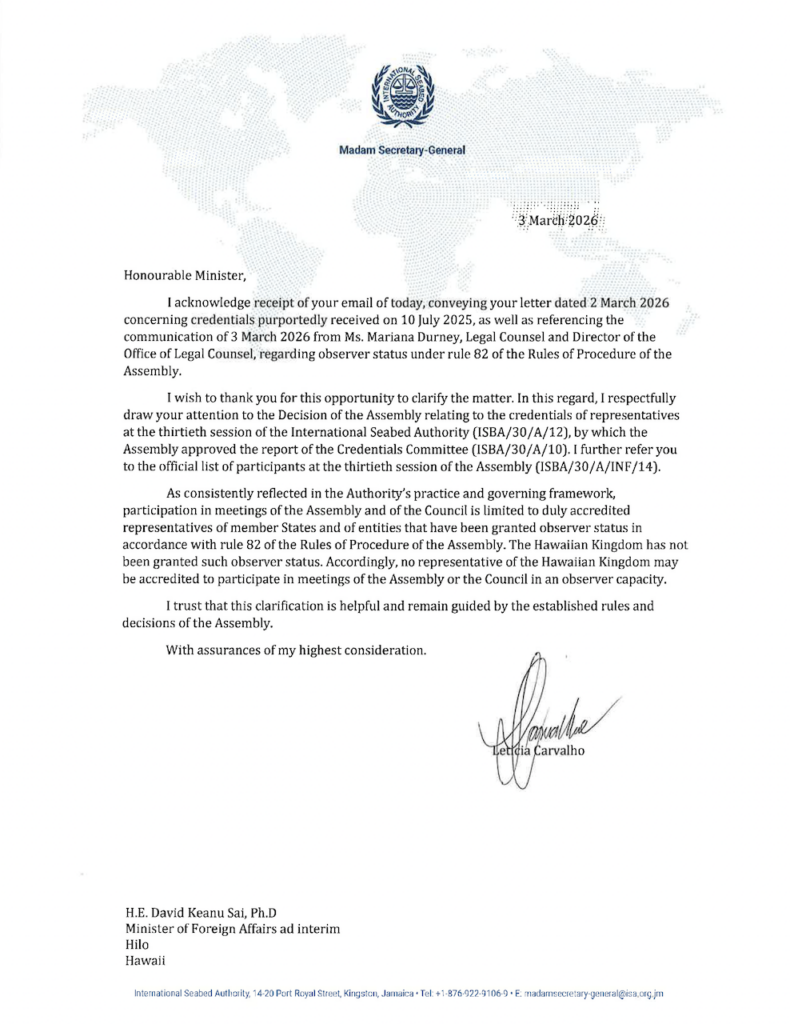
Later that day of the same date, Minister Dr. Sai received an email, with an enclosed  “formal letter,” from Secretary General Carvalho clarifying the rules and practice for a State to participate in meetings of the ISA as an observer.

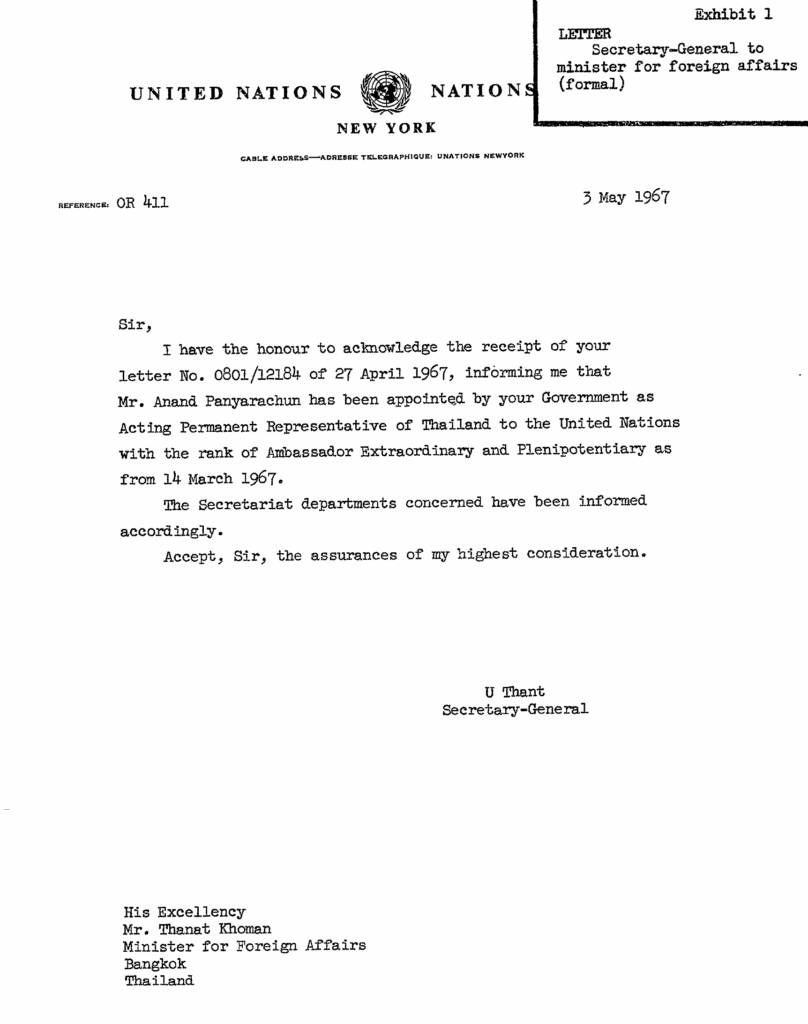
According to the United Nations Correspondence Manual, “Formal letters are those employing diplomatic style and phraseology. Normally such letters are addressed only to heads of State or heads of Government, ministers for foreign affairs and [Ambassadors].” And that “Formal letters to ministers for foreign affairs […] should, as a rule, include the name of the addressee in the address. The address should also contain full personal titles such “His Excellency.” Here is an example of a formal letter from the Secretary General of United Nations to a Minister of Foreign Affairs.

In her formal letter to Minister Dr. Sai, Secretary General Carvalho stated:

On March 5, 2026, Minister Dr. Sai acknowledged receipt of Secretary General Carvalho’s communication, dated March 3, 2026. In his letter to the Secretary General, Minster Dr. Sai stated:

Excellency:

This letter acknowledges your email, of 3 March 2026, which enclosed your letter of the same date, and the email from Ms. Mariana Durney, Legal Counsel and Director of the Office of Legal Counsel, of 3 March 2026, which enclosed her letter of the same date. I wish to thank you for Your Excellency’s recognition of the Hawaiian Kingdom as a State, under customary international law, since the nineteenth century, despite the prolonged nature of the belligerent occupation, by the United States of America, that began on 17 January 1893.

The International Seabed Authority’s recognition is consistent with the recognitions of the Hawaiian Kingdom by the Permanent Court of Arbitration during arbitral proceedings in Larsen v. Hawaiian Kingdom from 1999 to 2001, by the United States’ recognition of the Hawaiian Kingdom under the 2000 Sai-Clinton agreement, a treaty under international law, and by the 127 Contracting States to the 1907 Hague Convention, I, for the Pacific Settlement of International Disputes that established the Permanent Court, under opinio juris.

Of the 169 Member States of the International Seabed Authority, 111 of these States are also Member States of the Permanent Court, to wit: Albania, Argentina, Armenia, Australia, Austria, Bahamas, Bahrain, Bangladesh, Belarus, Belgium, Belize, Benin, Bolivia (Plurinational State of), Brazil, Bulgaria, Burkina Faso, Cameroon, Canada, Chile, China, Congo, Costa Rica, Croatia, Cuba, Cyprus, Czechia, Democratic Republic of the Congo, Denmark, Djibouti, Dominican Republic, Ecuador, Egypt, Estonia, Eswatini, Fiji, Finland, France, Georgia, Germany, Greece, Guatemala, Guyana, Haiti, Honduras, Hungary, Iceland, India, Indonesia, Iraq, Ireland, Italy, Japan, Jordan, Kenya, Kuwait, Lao People’s Democratic Republic, Latvia, Lebanon, Lithuania, Luxembourg, Madagascar, Malaysia, Malta, Mauritius, Mexico, Mongolia, Montenegro, Morocco, Netherlands, New Zealand, Nicaragua, Nigeria, North, Macedonia, Norway, Pakistan, Panama, Paraguay, Philippines, Poland, Portugal, Qatar, Republic of Korea, Romania, Russian Federation, Rwanda, Sao Tome and Principe, Saudi Arabia, Senegal, Serbia, Singapore, Slovakia, Slovenia, South Africa, Spain, Sri Lanka, State of Palestine, Sudan, Suriname, Sweden, Switzerland, Thailand, Timor-Leste, Togo, Uganda, Ukraine, United Kingdom of Great Britain and Northern Ireland, Uruguay, Vanuatu, Viet Nam, Zambia, and Zimbabwe. And there are 15 Observer States that are also Member States of the Permanent Court of Arbitration, to wit: Cambodia, Colombia, El Salvador, Eritrea, Ethiopia, Iran (Islamic Republic of), Israel, Kyrgyzstan, Libya, Liechtenstein, Peru, Turkey, United Arab Emirates, United States of America, and Venezuela.

My communication of 28 July 2025 to Ms. Durney, provided her the factual and legal basis of the Hawaiian Kingdom’s continued existence as a State, under customary international law, and the restoration of the government by a Council of Regency under Hawaiian constitutional law and the legal doctrine of necessity, so that it can pursue Observer State status under rule 82 of the Rules of Procedure of the Assembly of the International Seabed Authority.

I wish to thank you for your clarification of the rules and practices of the International Seabed Authority regarding observer status. The Hawaiian Kingdom intends to pursue its observer status accordingly so that its Special Envoy can be accredited to participate in meetings of the Assembly or the Council under Rule 82 of the Rules of Procedure of the Assembly.

Please accept, Excellency, the expression of my highest consideration.

[signed]
H.E. David Keanu Sai, Ph.D.
Minister of Foreign Affairs ad interim
Her Excellency Letitia Carvalho
Secretary General of the International Seabed Authority
14-20 Port Royal Street
Kingston, Jamaica

“The recognition of the Hawaiian Kingdom’s continued existence as a State under international law by the Secretary General of the International Seabed Authority is a significant act taken by a reputable international body represented by 171 countries,” stated Minister Dr. Sai. He explained, “The Hawaiian Kingdom took deliberate steps to become accredited as an Observer State so that it can participate in meetings of the International Seabed Authority, because its fisheries and marine environment in its 200-mile Exclusive Economic Zone has been unlawfully exploited by the United States for over a century.”

Minister Dr. Sai also stated, “The Hawaiian Kingdom will now proceed toward securing Observer State status so that its Special Envoy can participate in the meetings of the Council and the Assembly of the ISA in the very near future.”

MEDIA CONTACT:

Dr. David “Keanu” Sai, Ph.D.
Chairman of the Council of Regency
Acting Minister of the Interior
Acting Minister of Foreign Affairs ad interim
Email: interior@hawaiiankingdom.org