On January 23, 2026, U.S. District Judge Micah Smith issue an order denying the Council of Regency of the Hawaiian Kingdom’s Motion to Intervene in the federal lawsuit Students for Fair Admissions v. Kamehameha Schools. The Council of Regency is intervening as the government of the Hawaiian Kingdom.
The lawsuit, brought by Students for Fair Admissions (SFFA), seeks to dismantle the Native Hawaiian admissions policy of Kamehameha Schools—an institution created by Aliʻi Bernice Pauahi Bishop to uplift and educate Hawaiian children. SFFA claims that Kamehameha Schools’ policy violates U.S. civil rights law and is premised on the assertion that Hawaiʻi was lawfully annexed and fully absorbed into the United States more than a century ago.
The Council of Regency’s intervention is necessary because this case is built on fundamental historical and legal inaccuracies that neither party before the Court can correct. At stake is not only the future of Kamehameha Schools, but the integrity of Hawaiian Kingdom law, the rights of the Hawaiian people, and the protection of future generations who were the express beneficiaries of Pauahi’s trust.
U.S. civil rights law, which includes all U.S. laws and administrative measures, cannot be imposed within the territory of the occupied Hawaiian Kingdom, which constitutes the war crime of usurpation of sovereignty during military occupation. The United States has recognized usurpation of sovereignty during military occupation as a war crime since the First World War.
As an occupied State, only Hawaiian Kingdom law applies in this case, which allows preferential admissions to Hawaiian children. The Council of Regency is intervening to protect Kamehameha Schools, which was called the Bishop Estate in the nineteenth century.
Kamehameha Schools was created under the laws of the Hawaiian Kingdom in the nineteenth century, at a time when Hawaiʻi was an internationally recognized sovereign State with treaties, diplomats, and a functioning constitutional government. Pauahi’s will was accepted by the Hawaiian Kingdom probate court in 1885—years before the illegal overthrow of the government of Queen Liliʻuokalani on January 17, 1893. Those laws did not disappear with the arrival of U.S. troops.
Under international law, the overthrow of a government does not extinguish the State itself. In 1997, the government of the Hawaiian Kingdom was restored as a Regency under Hawaiian constitutional law and the legal doctrine of necessity.
On February 3, 2026, the Council of Regency, as interim government of the Hawaiian Kingdom, filed its Motion for Reconsideration with the United States District Court for the District of Hawai‘i, seeking reconsideration of Judge Smith’s order denying the Hawaiian Kingdom’s Motion to Intervene in the federal lawsuit filed on January 21, 2026.
The Hawaiian Kingdom argues that Judge Smith committed “manifest errors of law” including its misapplication of the political question doctrine at the intervention stage. The political question doctrine bars federal courts from adjudicating disputes that are “textually committed” by the U.S. Constitution to another branch or lack judicially manageable standards to resolve. In the case of Hawai‘i, the court invoked this doctrine because it falsely asserted that the United States executive branch has not recognized the Hawaiian Kingdom. In this case, the Hawaiian Kingdom provides conclusive evidence that Judge Smith’s order is a “manifest error.”
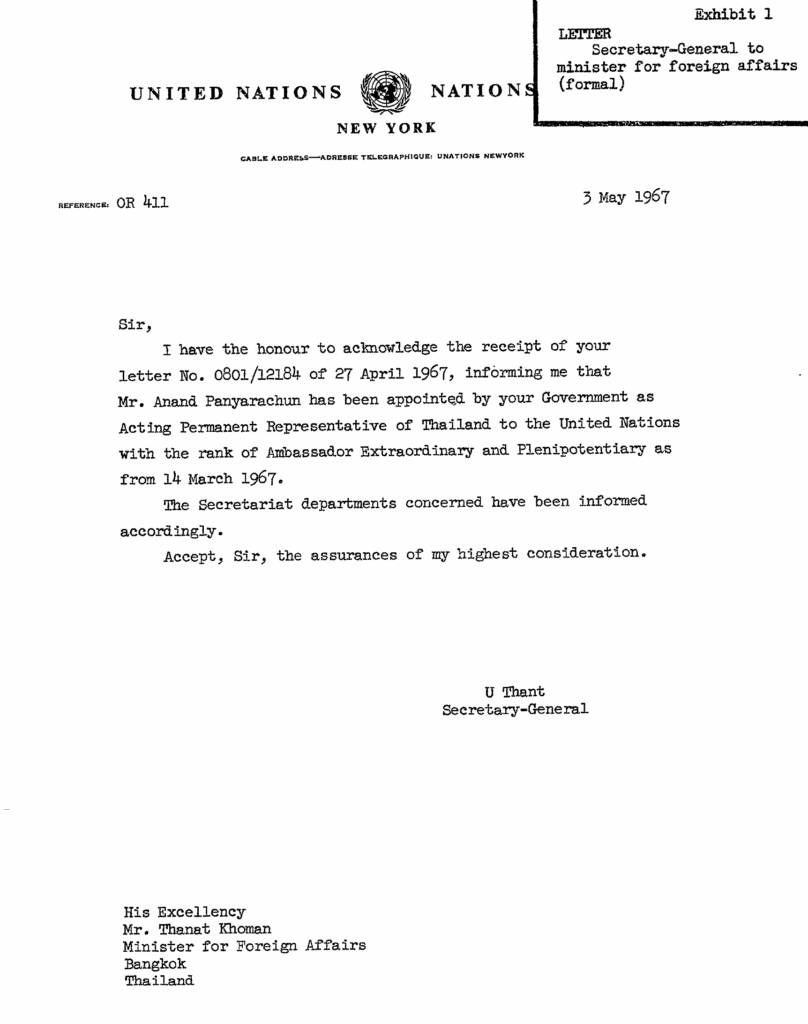
In its motion for reconsideration, the Council of Regency provided two explicit evidence that the United States recognized the continued existence of the Hawaiian Kingdom as a State and the Council of Regency as its interim government during international arbitration proceedings at the Permanent Court. The first piece of evidence is when the United States entered into an executive agreement with the Council of Regency, called the 2000 Sai-Clinton agreement, for it to have access to all records and pleadings of the international arbitration case of Larsen v. Hawaiian Kingdom at the Permanent Court of Arbitration from 1999-2001.
The second piece of evidence is under opinio juris—customary international law, when it did not object to the Permanent Court’s recognition of the Hawaiian Kingdom and the Council of Regency before it formed the arbitration tribunal on June 9, 2000. By not objecting, the United States accepted the Permanent Court’s recognition of the Hawaiian Kingdom and the Council of Regency. Here is a link to a memorandum that explains the circumstances of this evidence under international law published by the Hawaiian Kingdom’s Foreign Ministry.
On the matter of opinio juris—customary international law, none of the current 127 Contracting States to the treaty that formed the Permanent Court, to include the United States, objected to the Permanent Court’s conclusion that the Hawaiian Kingdom continues to exist and that it is a non-Contracting State under Article 47 of the treaty permitting the Hawaiian Kingdom access to the Permanent Court. Article 47 states, the “jurisdiction of the Permanent Court may…be extended to disputes [with] non-Contracting Powers.” In international law, “Powers” is used interchangeably with “States.”
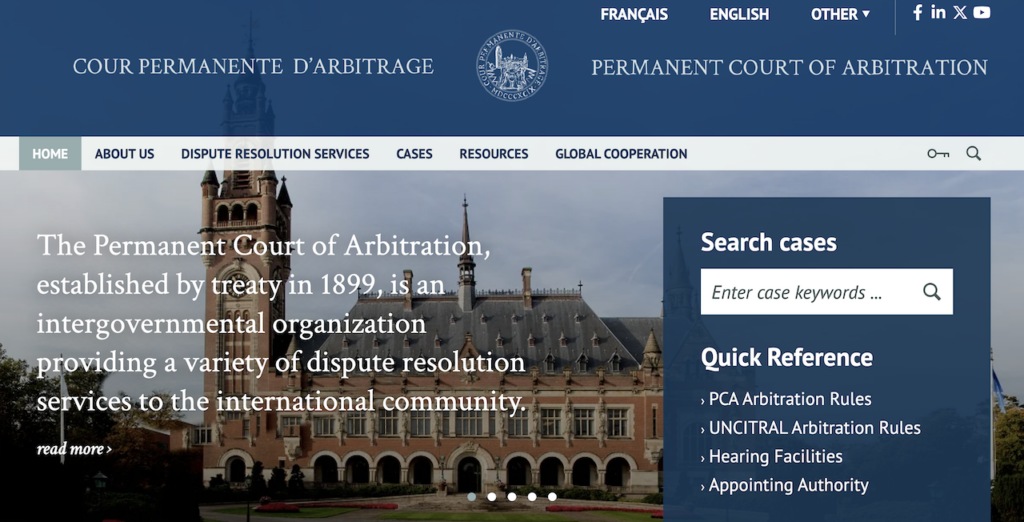
Under opinio juris, the practice of the Permanent Court includes its case description on its website that was not objected to by the United States. It states:
Lance Paul Larsen, a resident of Hawaii, brought a claim against the Hawaiian Kingdom by its Council of Regency (“Hawaiian Kingdom”) on the grounds that the Government of the Hawaiian Kingdom is in continual violation of: (a) its 1849 Treaty of Friendship, Commerce and Navigation with the United States of America, as well as the principles of international law laid down in the Vienna Convention on the Law of Treaties, 1969 and (b) the principles of international comity, for allowing the unlawful imposition of American municipal laws over the claimant’s person within the territorial jurisdiction of the Hawaiian Kingdom.
The case description by the Permanent Court states that the Council of Regency is the government of the Hawaiian Kingdom. The 1849 Treaty of Friendship, Commerce and Navigation with the United States of America continues to exist, and the imposition of American laws within Hawaiian territory is “unlawful.”
On February 16, 2026, the Hawaiian Kingdom filed its motion for leave to file supplemental brief in support of motion for reconsideration that provided additional evidence of the Council of Regency being the interim government of the Hawaiian Kingdom.
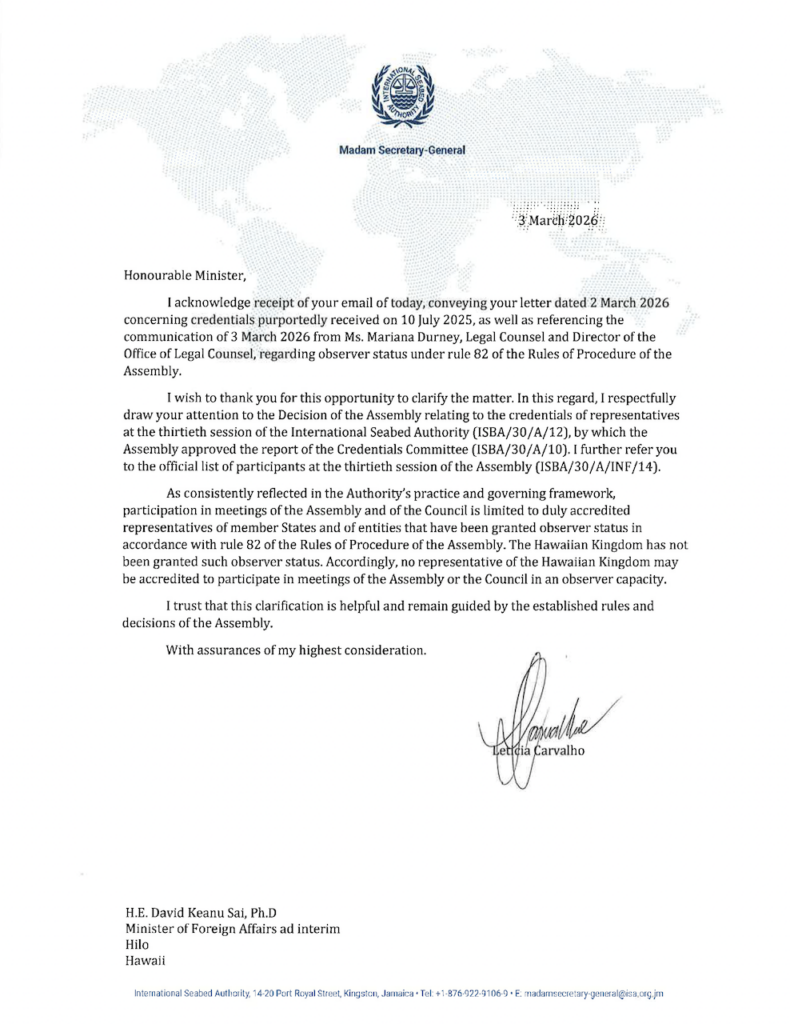
Added to the Permanent Court, is the recognition of the Hawaiian Kingdom by the International Seabed Authority (ISA). In a formal letter, dated March 3, 2026, from the ISA’s Secretary General, Letitia Carvalho, to Hawaiian Kingdom Minister of Foreign Affairs ad interim, Dr. David Keanu Sai, Ph.D., the ISA recognized the continued existence of the Hawaiian Kingdom as a State since the nineteenth century and its status as an Observer State. In her letter, the Secretary General clarifies the rules and practice of the ISA for a State to acquire observer status under Rule 82 of the Rules of Procedure of the Assembly of the ISA.
The ISA is an international organization that is composed of representatives of States that are Contracting States to the 1982 United Nations Convention on the Law of the Sea (UNCLOS). The headquarters of the ISA is in Kingston, Jamaica, where the Council and the Assembly of the ISA meet in session. Currently, the membership of the ISA is comprised of the European Union and 171 Contracting States to the UNCLOS.
According to Civil Beat, “Leticia Carvalho, the secretary-general of the ISA, said last week that she wants to finalize global rules governing seabed mining by the end of this year, a reversal of her previous position that the regulations could take several years to finalize, in part a reaction to President Donald Trump’s aggressive push to mine both U.S. and international waters outside the international regulatory framework.”
On March 5, 2026, Minister Dr. Sai provided a formal letter to the Secretary General acknowledging receipt of her letter, as requested, and thanking her for the ISA’s recognition of the continued existence of the Hawaiian Kingdom as a State since the nineteenth century and the Council of Regency as its interim government.
On March 10, the Council of Regency filed a Motion for Leave to file Letters Supplement in Support of Motion for Reconsideration. These letters from the ISA Secretary General and the Hawaiian Kingdom’s Minister of Foreign Affairs affirm the legal standing of the Council of Regency as the government of the Hawaiian Kingdom, which is at the core of the Hawaiian Kingdom’s Motion for Reconsideration. The legal standing of the Hawaiian Kingdom and the Council of Regency, as its interim government, prevents Judge Smith from invoking the political question doctrine.