
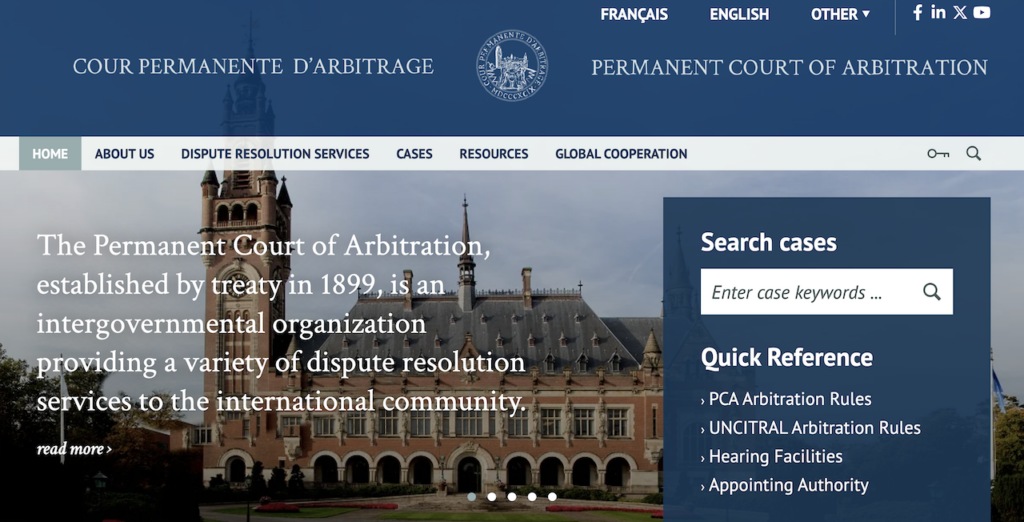
In April of 2000 began an exchange of diplomatic notes between the Hawaiian Kingdom Government and the United States Government, and between the Hawaiian Kingdom Government and the Permanent Court of Arbitration, The Hague, Netherlands. International arbitration proceedings were initiated by Lance Larsen’s legal counsel filing a notice of arbitration with the Permanent Court on November 8, 1999. At the center of the international dispute was the allegation by the claimant—Larsen, that the respondent—the Government of the Hawaiian Kingdom was liable “for allowing the unlawful imposition of American municipal laws over the claimant’s person within the territorial jurisdiction of the Hawaiian Kingdom.”
Before the arbitral tribunal was formed by the Permanent Court on June 9, 2000, in Larsen v. Hawaiian Kingdom, Tjaco T. van den Hout, Secretary General of the Permanent Court, spoke with the Chairman of the Council of Regency, David Keanu Sai, who served as agent for the Hawaiian Kingdom, over the telephone and recommended that the Hawaiian Government provide an invitation to the United States to join in the arbitration.
On April 3, 2000, the first diplomatic note was delivered by Chairman Sai to John R. Crook, Assistant Legal Adviser, United States Department of State. This note covered a conference call meeting in Washington, D.C., on that day between Chairman Sai, Crook, and Ms. Ninia Parks, legal counsel for Lance Larsen, where the Government of the Hawaiian Kingdom provided a formal invitation for the United States to join in international arbitration proceedings already in train at the Permanent Court, in Larsen v. Hawaiian Kingdom.
A copy of the note was sent to the Permanent Court’s Registry for record that the United States was invited to join in the arbitral proceedings. Under international law, this note served as an offering instrument that contained the following language:
[T]he reason for our visit was the offer by the…Hawaiian Kingdom, by consent of the Claimant [Larsen], by his attorney, Ms. Ninia Parks, for the United States Government to join in the arbitral proceedings presently instituted under the auspices of the Permanent Court of Arbitration at The Hague, Netherlands. … [T]he State Department should review the package in detail and can get back to the Acting Council of Regency by phone for continued dialogue. I gave you our office’s phone number…, of which you acknowledged. I assured you that we did not need an immediate answer, but out of international courtesy the offer is still open, notwithstanding arbitral proceedings already in motion. I also advised you that Secretary-General van den Hout of the Permanent Court of Arbitration was aware of our travel to Washington, D.C. and the offer to join in the arbitration. As I stated in our conversation he requested that the dialogue be reduced to writing and filed with the International Bureau of the Permanent Court of Arbitration for the record, and you acknowledged.
Thereafter, the Permanent Court’s Deputy Secretary General, Phyllis Hamilton, informed Chairman Sai over the phone that Cynthia Perrin Schneider, Ambassador of the United States to the Kingdom of the Netherlands, notified the Hawaiian Kingdom, through the Permanent Court, that the United States declined the invitation to join the arbitral proceedings. Ambassador Schneider was representing Bill Clinton, President of the United States. Instead, the United States requested permission from the Hawaiian Government to have access to the pleadings and records of the Larsen case at the Registry of the Permanent Court. Chairman Sai consented to this request. The Permanent Court, represented by the Deputy Secretary General, served as an intermediary to secure an agreement, by exchange of notes, between the Hawaiian Kingdom and the United States.
According to Johst Wilmanns, in his article “Note Verbale,” published in the Encyclopedia of Public International Law, “Legally there is no difference between a formal note, a note verbale and a memorandum. They are all communications which become legally operative upon the arrival at the addressee. The legal effects depend on the substance of the note, which may relate to any field of international relations.” And according to Cendric van Assche, in her chapter “1969 Vienna Convention,” in The Vienna Conventions on the Law of Treaties, A Commentary, “the exchange of two notes […] constituting an agreement satisfies the definition of the term ‘treaty’ as provided by Article 2(1)(a) of the Vienna Convention.”
This treaty providing permission for the United States to access all records and pleadings of the Larsen case at the Registry of the Permanent Court is called the 2000 Sai-Clinton agreement. Coincident with this treaty is the recognition of the continued existence of the Hawaiian Kingdom since the nineteenth century and the Council of Regency as its interim government. The 2000 Sai-Clinton agreement has similar parallels to the 1933 Roosevelt-Litvinov agreement where the United States recognized the Soviet Government.
The offer by the Permanent Court’s Secretary General to have the Hawaiian Government provide the United States an invitation to join in the arbitral proceedings, and the Hawaiian Government’s acceptance of this offer, also constitutes an international agreement between the Permanent Court and the Hawaiian Kingdom. According to J.L. Weinstein, in his article, “Exchange of Notes,” in the British Yearbook of International Law, “the growth of international organizations and the recognition of their legal personality has resulted in agreements being concluded by an exchange of notes between such organizations and states.” This treaty is called the Sai-van den Hout agreement.
There is no question of law or fact that by virtue of the Sai-Clinton agreement, the United States recognizes the continued existence of the Hawaiian Kingdom since the nineteenth century and that American laws and administrative measures being imposed within the territory of the Hawaiian Kingdom is UNLAWFUL. Section 6 and 8 of the Hawaiian Kingdom Civil Codes states:
§6. The laws are obligatory upon all persons, whether subjects of this kingdom, or citizens or subjects of any foreign State, while within the limits of this kingdom, except so far as exception is made by the laws of nations in respect to Ambassadors or others. The property of all such persons, while such property is within the territorial jurisdiction of this kingdom, is also subject to the laws.
§8. Whatever is done in contravention of a prohibitory law is void, although the nullity be not formally directed.
As a result, the United States, through its State of Hawai‘i, must begin to comply with the international law of occupation and begin to administer the laws of the Hawaiian Kingdom, which the provisional laws proclaimed in 2014, until there is a treaty of peace. Under the law of occupation, the State of Hawai‘i must transform itself into a Military Government. The Council of Regency has published its Operational Plan for Transitioning the State of Hawai‘i into a Military Government in 2023 with essential and implied tasks.
Wow, things must be moving fast. This is the first time I’ve seen the Hawaiian Kingdom make a post on a Saturday. Judge Smith, cannot say the Hawaiian Kingdom doesn’t exist because the US, conversed with them simply by declining to attend the hearings for Larsen vs The Hawaiian Kingdom. But that’s not all they actually asked the Hawaiian Kingdom if they could have full access to the records of the case.
👍
Don’t you think they asked for these proceedings to see how they could avoid it or to get around it? I’m rooting to have this fixed! They know there not doing the right thing. And doing similar to others in the World which is sad. But they can and will be held responsible for their actions in more ways then anyone knows! Malama Pono
“There is no question of law or fact that by virtue of the Sai-Clinton agreement, the United States recognizes the continued existence of the Hawaiian Kingdom since the nineteenth century and that American laws and administrative measures being imposed within the territory of the Hawaiian Kingdom is UNLAWFUL.”
INDEED. Those who have studied up over the years concur YET compliance greatly lags while the plunderers (via their corrupt BAR attorneys) CELEBRATE their ill-gotten spoils.
Thankfully we can NOW see signs of pro-Kanaka/Hawaiian changes in our community seemingly via reparations. Yet there’s no headway where it would matter the most– the legal realm of courts & law enforcement that work hand in hand. Judges will likely continue to IGNORE, DENY and SABOTAGE Hawaiian Kingdom’s lawful recognition in THEIR judicial system. I read somewhere that the judge doesn’t even have to reply to Sai’s request for reconsideration.
So what’s left? PDJT and/or military intervention to kick start COMPLIANCE. I’m looking forward to this week’s HNN’s The Rally Point in hopefully anticipation that MG Logan & other military WILL educate us civilians on what’s *really* going on in Hawaii nei!
Appreciate the quick succession of posts, Dr. Sai. Gives a sense of HOPE during some challenging times! 🌴
Well said, Mahalo Nui! America is horrible, look what’s happening to their Nation. I live on Kaua’i and share with all of our visitors the True History! Especially the part about Hawai’i being the target for any Nuclear Weapons, it would be coming to Kaua’i first where the intercepting missile would be launched from PMRF (Pacific Missile Range Facility) on our West side called Mana past Kekaha.
Excellent DETAILED 2023 article about Hawaiian Kingdom’s OUT of #Occupation Operational Plan & US Military’s OBLIGATION to follow thru while clarifying that *only* a military “governor” has to be in place (while the civilian gov remains). However, recall the US mil was placing mil throughout HI Gov per a work agreement.
Article states the US military is the MOST REGULATED US organization, operating like its OWN government w/o a legislative body. Hence, it appears our current Hawaii TAG AG Stephen Logan IS our “military governor” guided by the 322nd Civil Affairs Brigade at Fort Shafter, Oahu, on the function of transitioning governance/military Gov per US Army Field Manual 3-57 [manual for Civil Affairs units]. It’s also implied that MG Hara may have *started* the process August 14, 2023, so “the occupation can come to an end in 3 years”– this August 2026???
I may be reading too much between the lines yet it appears that once the Council of Regency approved its Operational Plan for Transitioning the Military Government into the Hawaiian Kingdom Government & drafted a proposed Treaty of Peace, the 3-year plan OUT OF OCCUPATION began to roll out. My only Q is why *that’s not* apparent in our LEGAL system yet? 🤨
P.s. Don’t forget to watch this week the (((new))) MILITARY program for civilians on Hawaii News Now called The Rally Point, biweekly streamed on Wednesdays. Eventually they MAY finally clue in the public on what’s *really* going on! 😎
https://www.transcend.org/tms/2023/09/operational-plan-for-transitioning-the-military-government-into-the-hawaiian-kingdom-government/edged this in Larsen v. Hawaiian Kingdom in 1999.
I tried clicking on the website you shared. It says it no longer exists.😳
Try this one Sue 🙃
https://www.transcend.org/tms/2023/09/operational-plan-for-transitioning-the-military-government-into-the-hawaiian-kingdom-government/
Interesting recent uptick in videos featuring Hawaii’s faux governor Green. He says around the 1 minute mark, “A lot of people are concerned, and it’s my role to be here, be present, and TO BE WORKING ON CONTINUITY OF GOVERNMENT (COG).”
The phrase “continuity of government” appears in the US DOD’s Law of War Manual (revised 2023), particularly in sections on BELLIGERENT OCCUPATION (e.g., 11.2.2 on maintaining public order and 18.4 on governance continuity in OCCUPIED territories). There, it relates to an occupying power’s OBLIGATIONS under the Hague and Geneva Conventions to preserve the occupied state’s institutions and laws where possible, while ensuring administrative functions continue without annexing sovereignty.
In the context of Hawaiian sovereignty arguments—where the absence of a ratified treaty ceding the Hawaiian Kingdom to the U.S. is cited as evidence of unlawful occupation—some advocates interpret such statements as implicit acknowledgments of a “continuity” under international law of war.
If the State of Hawaii is viewed as an OCCUPYING administration, Green’s role in “working on continuity of government” could be reframed as FULFILLING OCCUPIER DUTIES to maintain order without legitimate sovereignty.
https://youtu.be/rrK7_sDbGY0?si=RMwHLJFXRymPgy_y
THIRD 2026 published piece featuring Hawaii Governor Josh Green… What’s up? 👀
The February 2026 issue of Honolulu Magazine features a cover story titled “Green Day – HONOLULU Sits Down With Governor Josh Green”
Who is Hawaii’s Josh Green?
… A TV persona is just that, an image. Given the stakes in Hawai‘i, it’s not impolite or unfair to question whether Green is *really* a competent politician…
Per JG:
My mom was a politician. His _____ was an organizer for the National Organization for Women (NOW). His grandmother was a regional president of Planned Parenthood. And he’s a Woodstock baby, born in nearby Kingston, New York, in 1970.
Photo: Green poses with President Joe Biden on February 11. ALSO NOTE their first child was born on 2/11. Their first date anniversary is 2/11. And at the time of this interview, their son was 11. Numerology?
https://www.honolulumagazine.com/governor-josh-green-hawaii/
MEANWHILE, there’s a grassroot effort to IMPEACH Green while all this RECENT ‘good press’ is being done for him…
Main complaint? ‘His’ NEVERENDING emergency proclamations (EP) “shift operational control in multiple domains traditionally governed by legislative statute. While emergency authority is lawful and sometimes necessary, the cumulative effect across several domains warrants legislative awareness & review to ensure that temporary measures do not become de facto substitutes for ordinary legislative governance.”
Yet those of us here can probably guess that these continual EPs (((allow))) flexibility in strategic maneuvering & leadership— for covert military leadership during our transition??? HOPE that MG Logan or whomever military spokesperson starts touching upon some of this during the NEXT “The Rally Point” broadcast on Hawaii News Now (bi-weekly on Wednesdays? Last week didn’t happen).
https://www.standtogetherhawaii.com/_files/ugd/86fc0c_a30b24e1ddf149a1b474b45c1d25e2e5.pdf
Seems that the Council of Regency has Joe Rogan’s likely support & could use his platform to help get TRUTH out more broadly! When the time is right, Dr. Sai, please contact him to help share Hawaii’s TRUTH.
Here’s a clip of Joe Rogan (2023?) on Hawaii & its Sovereignty “Hawaii should be it’s own country … it’s own people… It’s NOT America yet should be protected by America.. . it should be sovereign…”
https://www.tiktok.com/@scrappahlani/video/7201142645677231402?is_from_webapp=1&sender_device=pc
I don’t agree with his statement that “Hawai’i is protected by the US”. The US has never protected Hawai’i. They have only done harm to Hawai’i.
Think he was referring to US being a “protectorate” of HK, like Britain was earlier on that resulted in the British Union Jack being part of the Hawaii flag.
It seems that US will remain as Hawaii’s ‘protectorate’ since they’re NOT getting rid of all the bases, yet HAVE relinquished (by not renewing leases) over 6,000 acres thus far. Therefore, will HI be protected as part of the USA military’s “Golden Dome”?
One thing FOR SURE they won’t be paying $1 to lease anymore esp. since Kumu Sai ENDED the Pearl Harbor Convention ‘contract’ years back.
🤔
https://hawaiiankingdom.org/blog/?s=Pearl+Harbor+Convention+&submit=Search
Here’s something interesting regarding the 1915 Probate for #KamehamehaSchool, “The Trustees under the Will and the Estate of Bernice Pauahi Bishop…” ?
The speaker says, “If you are unsure why I do NOT believe the Kamehameha Schools trust is valid… here’s some information you make the decision…” #HawaiianKingdom
https://www.facebook.com/reel/904676932165122
1:14:00 Greens opinion on Hawaiian Sovereignty… and his usurpation of such.
https://youtu.be/jbP78JE8Ygc?si=wSLQzaho_6FhZn8o
It’s CLEAR gov green is (((now))) being portrayed as some innocent soul, pro-locals & Hawaiians etc… YET during the scamdemic then Lahaina DEW attack which he still calls a “wildfire” [yet DEW tech has been around since 1958 per the nearly 100 patents], he was ONLY vax-pushing & was stating immediately he would ‘find a way for gov to buy the Lahaina Ohana lands’ RIGHT AFTER the torching.
Even during his alumni commencement speech at Swarthmore College (5/22/22) he said (at 2:24), “I speak in front of an entire state all the time, and it is much more nerve wracking to speak in front of brilliant people like you.” [compared to locals!?]
https://youtu.be/UQfJqD5GWvw?si=t4IJRMFgVKix6Ra_
Also, he has NOT ONCE called or mentioned Major General Stephen Logan by HIS NAME. He either does NOT introduced him, or calls him TAG. Most recently he referred to him as “General” when referring to whom updated him in regards to IRAN & to not go to the Governor’s Ball in DC– so he could ensure Hawaii’s “Continuity of Government” (COG).
So he’s either a ‘dark hat’ who capitulated & now trying to redeem himself. Or he was a ‘white hat’ “CENTRAL CASTING” actor who played a lolo ‘dark hat’ & now is flipping since MG Logan is in charge— right?
🤷🏼♀️