
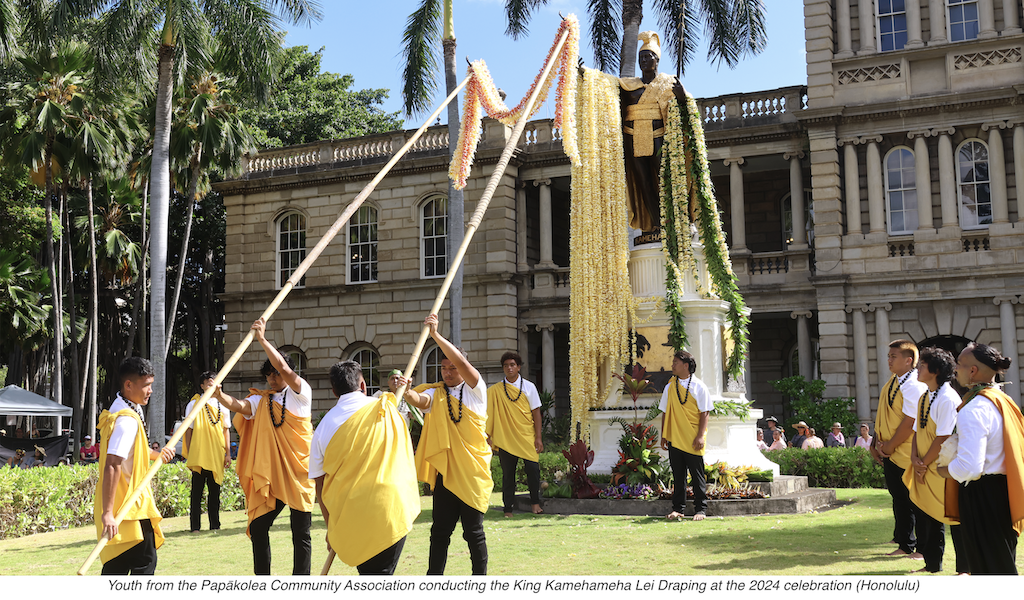
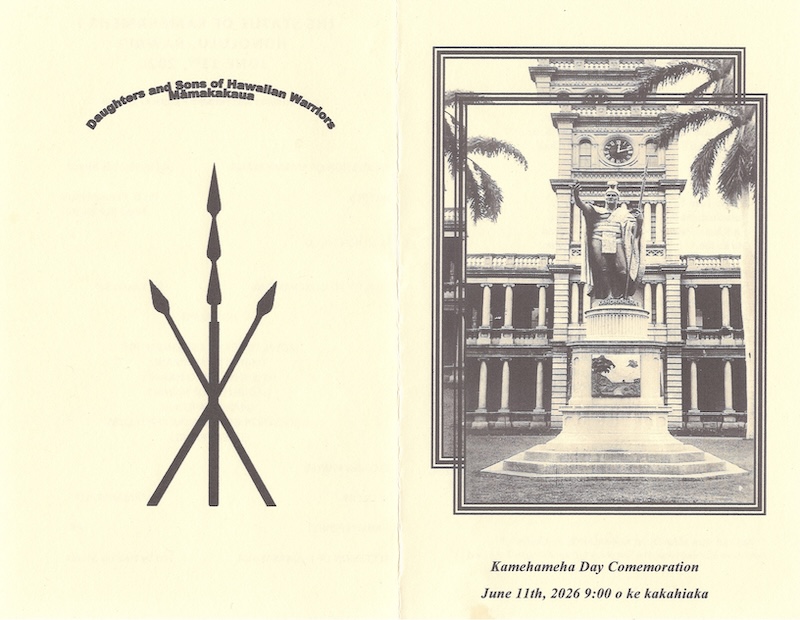
Yesterday, June 11th, was a Hawaiian Kingdom national holiday honoring King Kamehameha I the father of the Hawaiian Kingdom. The Daughters and Sons of Hawaiian Warriors – Māmakakaua have stood watch at the ceremony honoring Kamehameha I at his statue fronting Aliʻiolani Hale, the government building, since June 11, 1914. The statue was unveiled by King Kalākaua on February 14, 1883. Attending the ceremony were other Hawaiian Royal Orders and Societies.
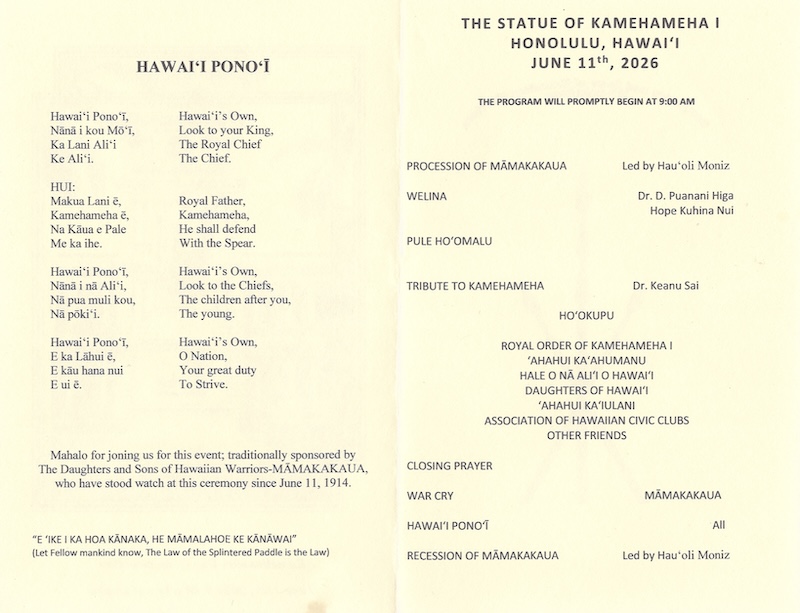
Dr. Keanu Sai was invited by the leadership of The Daughters and Sons of Hawaiian Warriors – Māmakakaua to give a tribute speech to Kamehameha. Here follows the speech Dr. Sai gave that day.
We gather today to commemorate Kamehameha I, Pai‘ea, the father of our country, the Hawaiian Kingdom. Kamehameha was not merely a great ali‘i; he was the chief whose leadership brought the Hawaiian Islands under one kingdom and established the foundation of our country. By 1810, through conquest and agreement, the islands were consolidated under his rule, and the country came to be known in the nineteenth century as the Hawaiian Kingdom.
It is important, on this day, that we remember Kamehameha not only as a warrior and aliʻi, but as the head of a developing nation. On February 24, 1794, while King of Hawaiʻi Island, Kamehameha entered into an agreement with Captain George Vancouver that placed Hawaiʻi under British protection. This relationship helps explain why the Union Jack appears on our national flag. The flag we see today is not the flag of the State of Hawaiʻi. It is the national flag of the Hawaiian Kingdom formally established by the Hawaiian Legislature in 1845.
During the reign of Kamehameha III, Kauikeaouli, the Hawaiian Kingdom became a constitutional monarchy in 1840. Three years later, on November 28, 1843, it was transformed from a British protectorate into an independent State — an event now commemorated as Lā Kūʻokoʻa, Hawaiian Independence Day. This is another important national holiday, alongside Kamehameha Day, which was declared in 1872 by Kamehameha’s grandson, King Kamehameha V, Lot Kapuāiwa.
My name is Dr. David Keanu Sai, and I serve as Acting Minister of the Interior and Acting Minister of Foreign Affairs ad interim for the Council of Regency of the Hawaiian Kingdom. The Council of Regency also includes His Excellency Dexter Kaʻiama, Acting Attorney General, and Her Excellency Kauʻi Sai-Dudoit, Acting Minister of Finance.
From 1999 to 2001, the Council of Regency represented the Hawaiian Kingdom as an independent State under an American occupation before the Permanent Court of Arbitration in The Hague, Netherlands. In the Larsen case, I served as lead agent of the legal team, with His Excellency Minister Umialiloa Sai serving as deputy agent, His Excellency Gary Dubin, acting Attorney General, serving as second deputy agent, and Her Excellency Minister Kau‘i Sai-Dudoit serving as third deputy agent.
On December 12, 2000, the national flag of the Hawaiian Kingdom was unfurled at The Hague alongside the national flags of Germany, France, Great Britain, and the Netherlands. That moment was significant because it placed the Hawaiian Kingdom within an international setting, alongside other countries, and affirmed the Council’s position that the Hawaiian Kingdom continues to exist under international law.
British novelist Donald James once wrote, “when a well-packaged web of lies has been sold gradually to the masses over generations, the truth will seem utterly preposterous and its speaker a raving lunatic.”
Since returning from oral hearings at the Permanent Court in December 2000, the Council of Regency has undertaken the work of restoring Hawaiian Kingdom national consciousness in the minds of the people through academic research, education, and publishing. This work is necessary because generations that have been subjected to Americanization obscured their understanding of the legal and political history of our country and narrowed our understanding of who we are.
Her Excellency Kauʻi Sai-Dudoit has been the director of the Hawaiian language newspaper project, Hoʻolaupaʻi and currently He Aupuni Palapala, and has worked to bring 114 years of Hawaiian knowledge back into contemporary spaces. As the Programs Director of Awaiaulu, she has built an online history resource for educators called Kīpapa Educator Resources.
After receiving my Ph.D. in political science from the University of Hawaiʻi at Mānoa in 2008, I authored in 2011 Ua Mau Ke Ea—Sovereignty Endures: The Legal and Political History of the Hawaiian Islands, which is a history book currently utilized in Hawaiʻi schools and early college courses. My most recent publication Hawaiʻi’s Sovereignty and Survival in the Age of Empire was published in 2024 by the renowned Oxford University Press in London. That work, together with the broader educational efforts of the Council and its members, is part of restoring knowledge of the Hawaiian Kingdom as a continuing State under international law.
Today, as we honor Kamehameha Pai‘ea, we are not looking backward. We are remembering the foundation of a country, the continuity of its national identity, and the duty we carry to restore Hawaiian national consciousness. Kamehameha’s legacy is not confined to the past. It continues in the work of remembering, teaching, and acting from the knowledge that the Hawaiian Kingdom endures. Hawai‘i is not the 50th State of the United States. It is the occupied State of the Hawaiian Kingdom. Let us recall, as we move forward, the words of our great leader, Kamehameha Paiʻea: “I mua e nā pōkiʻi, a inu i ka wai ʻawaʻawa. ʻAʻohe hope i hoʻi mai ai.” Go forward, young warriors, and drink the bitter waters, for there is no turning back.
Thank you to the Council of Regency for all it does for the Hawaiian Kingdom and its Nationals. Mahalo
Moana Hughes
How do we establish a better understanding of the situation of kuleana/stewardship
I always think it’s odd to celebrate Kamehameha when he is the individual responsible for the most kānaka maoli deaths than any one person in all of history. I think he was a tyrant. Queen Lili’uokalani’s, SHE deserves venerationy… not Kamehameha..
Why shouldn’t King Kamehameha deserve any respect?
Constant fighting between multiple kings and chiefs resulted with greater number Hawaiians dying. If he didn’t militarily conquer and unite all the islands, wars would not end. How many died because of war after he united all the kingdoms??? If wasn’t for him, Lili’uokalani would not be queen.
Amen. And when this unified Kingdom was born, we’ve kept the peace.
Aloha Nui Loa King Kamehameha Hawaiian Kingdom No Ka Oi
Here’s a short summary of his history– a complex (foretold) man that PROVED he could also change & adapt as he GREW the Hawaiian Kingdom…
Kamehameha the Great: The Warrior Who Unified Hawaiʻi
Born around 1758 on Hawaiʻi Island during the appearance of Halley’s Comet, Kamehameha (originally named Paiʻea) entered the world amid powerful prophecies. Kahuna foretold he would become a mighty ruler who would conquer all the islands. Rival chiefs saw him as a threat, so the infant was secretly hidden and raised in seclusion for his early years to protect him.
As a young man, he proved his strength—legend says he single-handedly moved the massive Naha Stone. A fierce and brilliant warrior, Kamehameha used traditional Hawaiian combat alongside newly acquired Western muskets and cannons. Through strategic battles, alliances, and key victories (including ʻĪao Valley and Nuʻuanu Pali), he unified the Hawaiian Islands under one rule by 1810.
His early conquests were often ruthless, as was common in chiefly warfare of the time. Yet he EVOLVED into a shrewd statesman. He traded with foreign ships, built a navy, established a royal monopoly on sandalwood, and skillfully managed relations with European powers to protect Hawaiian sovereignty.
One of his most enduring legacies is the Kānāwai Māmalahoe — the Law of the Splintered Paddle. After an incident where commoners defended themselves against him, he proclaimed that the vulnerable (women, children, and elderly) must be protected and could “lie by the roadside in safety.” This principle still influences Hawaiian law today.
Kamehameha I died in 1819, but his unification HELPED Hawaiʻi stand as an independent kingdom for nearly a century in a rapidly changing Pacific. A complex leader—fierce conqueror turned visionary unifier—whose story continues to inspire.
Kamehameha Day is celebrated every June 11, The first Kamehameha Day was celebrated in 1872 when the people of Hawaiʻi wanted to create a national holiday to honor King Kamehameha V (Lot Kapuāiwa) on his own birthday — December 11. Kamehameha V, a humble leader, declined the personal honor. He instead redirected the holiday to celebrate his GRANDFATHER, Kamehameha I (the Great) so he officially proclaimed June 11 as the date for this new holiday — deliberately chosen as roughly six months away from his own December 11 birthday.
P.s. Seems my previous post was deleted. Oh well.
keep this chatgpt slop where it belongs. the trash
u sound like an American amen.